Wednesday, June 29, 2022

Cape Cod (2022)

Cape Cod Picture 1

This noisy little image may be all I get but at least it shows what is not possible from my house.  The image was from a recent trip to Cape Cod for my wife's reunion (Harvard '91). It was on a beach off Surf Drive in Falmouth, MA.  The Skies were surprisingly dark and the Milky Way was as good as it was out west.  This was a 60 second exposure using my my trusty rusty Canon 600D with an Opteka 6.5mm Fisheye Lens at f/5.6 and ISO of 1600.  


Cape Cod Picture 2

This second noisy little image caps what I was able to capture the night on a beach. The image was from a recent trip to Cape Cod for my wife's reunion (Harvard '91). It was on a beach off Surf Drive in Falmouth, MA. There is a lot going on here, for example, the Lagoon Nebula (M8) sits in the upper center and just north of that is the Trifid Nebula (M20). The lower left is the constellation Sagittarius, nicknamed the Teapot. Numerous star clusters are scattered throughout and the dark dust lane bisects the bright Milk Way in two. This image was produced by stacking eight 15 second exposures with a 50mm Canon Lens at f/4 and ISO of 1600.

I would have had another and potentially better image but alas in my hurried haste I goofed up. I collected nine 6o second exposures. When you capture longer exposures you to account for Earth's rotation with a tracking mount which I had. However, the first thing you should do is polar align which is what forgot to do so the stars were tailing.

If you are wondering when you would need a tracker, there is a "rule of 500" where you divide 500 by the focal length of the lens and that number is the maximum time that you take a single exposure before a star shows trails. For example, if your focal length (FL) of the lens is 6.5 mm, then divide 500 by 6.5 you get 77, therefore you can take a 77 sec exposure without trailing. If your lens had a FL of 50 mm, then 500 divided by 50 gives you 10. So anything longer will begin to show trails. So my 15 second exposures do show a tiny amount of streaking, at 60 seconds the streaking was quite bad.


Monday, June 27, 2022

Lots of Stars & Dust, Iris Nebula - NGC 7023 Region (2022)

NGC 7023 or the Iris Nebula is a favorite of mine and I wanted to redo this object as I just did this exactly one year ago with this very lens - the Canon EF 200mm f/2.8 II USM Lens. Last year's image was with the ZWO ASI294MC and was plagued with problems of my own doing and poor weather conditions. This time around I did it with my new portable setup and it performed really well. This image is infinitely better than my previous attempt, of course capturing photons from Bortle 5 skies has its own issues.

The portable rig consists of a ZWO ASI2600MC, Canon EF 200mm f/2.8L II USM Lens, ZWO Filter Drawer for Canon Lenses, ADM dovetail and rings, ZWO ASI120 guide camera, ZWO Mini guidescope, iOptron Skyguider Pro, Williams Optics Base, and an iOptron Tripod.

The region is heavily laden with interstellar dust as can be seen in the image. The characteristic blue color from NGC 7023 comes from the dust grains reflecting light from the bright central star. Also interesting is that polyaromatic hydrocarbons (PAHs) have been detected within this nebula so it may be a good place to get some naphthalene (moth-balls). Located in the constellation Cepheus these molecular clouds are approximately 1,300 light-years away in a rich field of stars. Also in this widefield image is the Ghost Nebula, a.k.a. Sh2-136 (VdB 141), located in the upper middle region.

https://www.instagram.com/astroquest1/
http://astroquest1.blogspot.com/
https://www.astrobin.com/users/kurtzepp/collections/
http://youtube.com/c/AstroQuest1 


Iris Nebula - NGC 7023
Dates: 5-28, 5-29
Camera: ZWO ASI2600MC-Pro
Telescope: Canon EF 200mm f/2.8L II USM Lens
Barlow: None
Focal Length: 200mm
f/4 with stepdown rings
Focal Reducer: None
Mount: iOptron SkyGuider Pro
Filter Wheel/Drawer: ZWO EOS Filter Drawer
Filter: Baader UV/IR
Focuser: None
Autoguiding: ASI120 Mini attached to a ZWO Mini 30/120mm Guidescope
Exposure: 156 x 120
Gain: 100
Offset 20
Sensor Temp: 0 C
Processing: NINA, PixInsight, Photoshop, StarXTerminator.

https://www.instagram.com/astroquest1/
http://astroquest1.blogspot.com/
https://www.astrobin.com/users/kurtzepp/collections/
http://youtube.com/c/AstroQuest1

Sunday, June 12, 2022

Polaris Region - SH2-178

SH2-178 was originally thought to be a hydrogen emission nebula like most Sharpless objects, however, it is now known to be associated with the giant molecular cloud known as the Polaris Flare. This region contains a huge amount of dust that resembles cirrus clouds which reflect the light of the Milky Way. These clouds of dust reside well above the plane of the Milky Way and are also known as Integrated Flux Nebula (IFN).

I don't know why but I really love these dark dusty areas and this region has been on my to do list for a long time so it is a milestone of sorts. I first attempted this over two years ago but had many problems. I then attempted it again last year with but again - problems. This year was the charm. Why was this so tough? IFNs in general are very faint and require very dark skies - my Bortle 5 (at best) skies are pushing the limit. Nothing was in any of the subframes which is always disconcerting. The other reason this is difficult is that guiding close Polaris is tough as a tiny fluctuation is magnified. Even though I was only collecting 90 second frames at 200 mm FL, guiding is necessary - at least for my equipment. So if you want a challenge and you like being frustrated, why look no further, this object is for you.

This image also represents my second light with the ZWO ASI2600MC. I had it attached to my Sirius Mount in the astronomy shed and was guiding this time. Although this camera will mainly be used with a portable rig I wanted to get more practice. This object was a great learning experience as I collected over 400 frames and attempted to stack them using PIs WBPP like I always do. Well after 14 hours it did everything but Image Integration before I got no space left. After doing some research and posting questions, I purchased a 1 TB external SSD which will be for stacking purposes only. I then stacked it again with WBPP and after 26 hours I got an image. This was still too long so I did some more research and did some adjustments in PI and learned a bit about swap directories. Also, I had the generated drizzle data selected even though I was not drizzling so that may have been adding to the time.

I did have to crop the image on the right side as my neighbor's tree got in the way. When I started this there were no leaves on the trees so I did not realize it was a problem as I could have adjusted it. In addition to the dust, the stars were well shaped and quite colorful. I am very happy how the ASI2600 handles stars, even bright ones. I left Polaris slightly yellow rather turn it blue since it is a yellow supergiant - Polaris is actually a triple star system.

Dates: 4-30, 5-17, 5-19, 5-21

https://www.instagram.com/astroquest1/
http://astroquest1.blogspot.com/
https://www.astrobin.com/users/kurtzepp/collections/
http://youtube.com/c/AstroQuest1


Polaris Region - SH2-178
Dates: 4-30, 5-17, 5-19, 5-21
Camera: ZWO ASI2600MC-Pro
Telescope: Canon EF 200mm f/2.8L II USM Lens
Barlow: None
Focal Length: 200mm
f/4 with stepdown rings
Focal Reducer: None
Mount: Orion Sirius
Filter Wheel/Drawer: ZWO EOS Filter Drawer
Filter: Baader UV/IR
Focuser: None
Autoguiding: ASI120 Mini attached to a ZWO Mini 30/120mm Guidescope
Exposure: 401 x 90
Gain: 139
Offset 20
Sensor Temp: -10 C
Processing: NINA, PixInsight, Photoshop, Topaz DeNoiseAI, StarXTerminator.

https://www.instagram.com/astroquest1/
http://astroquest1.blogspot.com/
https://www.astrobin.com/users/kurtzepp/collections/
http://youtube.com/c/AstroQuest1

Monday, May 30, 2022

NGC 4567 and NGC 4568 (Siamese Twins)

Finally, I have been wanting to image this for a long time but never had enough focal length to do it justice until now. NGC 4567 and NGC 4568, commonly known as the Siamese Twins and also the Butterfly Galaxies, are located approximately 70 million light-years away in the constellation Virgo. To me the Butterfly makes the most sense if you feel it necessary to apply nicknames. These galaxies are in the early stages of colliding with each other so there is not much apparent disturbance between them yet. The galaxies are quite similar to each other but one interesting difference is the color, NGC 4568 appears slightly yellow and NGC 4567 appears slightly blue.

I left the field a bit larger than most images taken with similar equipment because I wanted to keep the yellowish galaxy NGC 4564 on the left and the fainter bluish galaxy IC 3578 on the right.  Many other faint fuzzies are scattered throughout this image.  Although I only stacked 173 subframes, I collected much more but weather conditions often deteriorate quite rapidly around these parts.  Lastly, you may have noticed the collection dates vs. the publication, this is due to a combination of factors such as the extra end of the school year stuff, my own projects, family stuff, waiting for better weather, and my own slow processing speed.    

Dates: 4-30, 5-17, 5-19, 5-21

https://www.instagram.com/astroquest1/
http://astroquest1.blogspot.com/
https://www.astrobin.com/users/kurtzepp/collections/
http://youtube.com/c/AstroQuest1


NGC 4567 and NGC 4568 (Siamese Twins)
Dates: 4-30, 5-17, 5-19, 5-21
Camera: ZWO ASI294MC-Pro
Telescope: Celestron EdgeHD 800
Barlow: None
Focal Length: 2032mm (native)
F/10 (native)
Focal Reducer: Celestron 0.7 Reducer Lens
Mount: Orion Atlas Pro
Filter Adaptor: ZWO Filter Drawer
Filter: Optolong Luminosity (2-inch)
Focuser: ZWO EAF
Autoguiding: ASI120 Mini attached to an Orion ST80
Exposure: Lum 173 x 90
Gain: 139
Offset 0
Temp: 0 C
Processing: Asiair app, PixInsight, Photoshop, StarXTerminator, GradientXTerminator, Topaz DeNoiseAI.

https://www.instagram.com/astroquest1/
http://astroquest1.blogspot.com/
https://www.astrobin.com/users/kurtzepp/collections/
http://youtube.com/c/AstroQuest1

Wednesday, May 25, 2022

NGC 5906 or NGC 5907 - Splinter Galaxy

Located approximately 50 million light-years away in the constellation Draco is an edge-on spiral galaxy known as NGC 5906 also known as NGC 5907. It also goes by the Splinter Galaxy and less commonly the Knife Edge Galaxy. It is a little bigger than our own galaxy at 180,000 light-years across and is known to be composed mainly of stars with low metallicity which means most of the stars have only hydrogen and helium and little else.

I started imaging this after reading Gary Imm's writeup for his excellent version of this. In his description he mentioned tidal streams discovered in 2006. I thought it might be cool to capture those streams. However, after doing more research I discovered they were captured by R.J. GaBany who specializes in these tidal streams and often works with professional astronomers (GaBany Image). I searched Astrobin and only found a couple of other images that somewhat show these and they were from very dark sites. Other images from astrophotographers much better than myself do not show the streams so I decided to forget this and go with the main part of the galaxy.

Despite the lack of streams it does have some interesting structure in that it appears elongated with many intersecting dust lanes especially on the right side of my image.  Lastly, this hopefully should be the last image which shows the menacing blips on some of the larger stars caused by loose a connection on my mount. I had a long talk with my quality control person who is responsible for setting up my equipment.

https://www.instagram.com/astroquest1/
http://astroquest1.blogspot.com/
https://www.astrobin.com/users/kurtzepp/collections/
http://youtube.com/c/AstroQuest1


NGC 5906 or NGC 5907 - Splinter Galaxy
Dates: 4-8, 4-12, 4-13
Camera: ZWO ASI294MC-Pro
Telescope: Celestron EdgeHD 800
Barlow: None
Focal Length: 2032mm (native)
F/10 (native)
Focal Reducer: Celestron 0.7 Reducer Lens
Mount: Orion Atlas Pro
Filter Adaptor: ZWO Filter Drawer
Filter: Optolong Luminosity (2-inch)
Focuser: ZWO EAF
Autoguiding: ASI120 Mini attached to an Orion ST80
Exposure: Lum 276 x 90
Gain: 139
Offset 0
Temp: -10 C
Processing: Asiair app, PixInsight, Photoshop, StarXTerminator, GradientXTerminator, Topaz DeNoiseAI.

https://www.instagram.com/astroquest1/
http://astroquest1.blogspot.com/
https://www.astrobin.com/users/kurtzepp/collections/
http://youtube.com/c/AstroQuest1

Tuesday, May 17, 2022

Lunar Eclipse 5-15-22

Here are some images that were luckily collected at Boothe Park at BMAS Eclipse Event as the weather was not promising. It was quite humorous as we set up for the first time when it was partially clear then it started rain so we broke down, then it cleared for a second time so we set up again then it started rain so we broke down again, then it cleared so we set up again for a third then it started rain so we broke down again, Finally it cleared somewhat and did not rain. Only Mark was smart enough to actually bring a cover.

My images were all taken with my modified Canon T3i (600d) and a Canon 200mm f/2.8L II USM Lens mounted on an iOptron Skyguider Pro. I was going to connect it to a telescope but decided to keep observing it instead - besides there are so many other great images from other people already.

Canon 200mm, f/4.0, ISO 400, 0.5s & 2s

Canon 200mm, f/4.0, ISO 400, 2s

Canon 50mm, f/4.0, ISO 400, 1s

Canon 200mm, f/4.0, ISO 400, 1/8s


Saturday, May 14, 2022

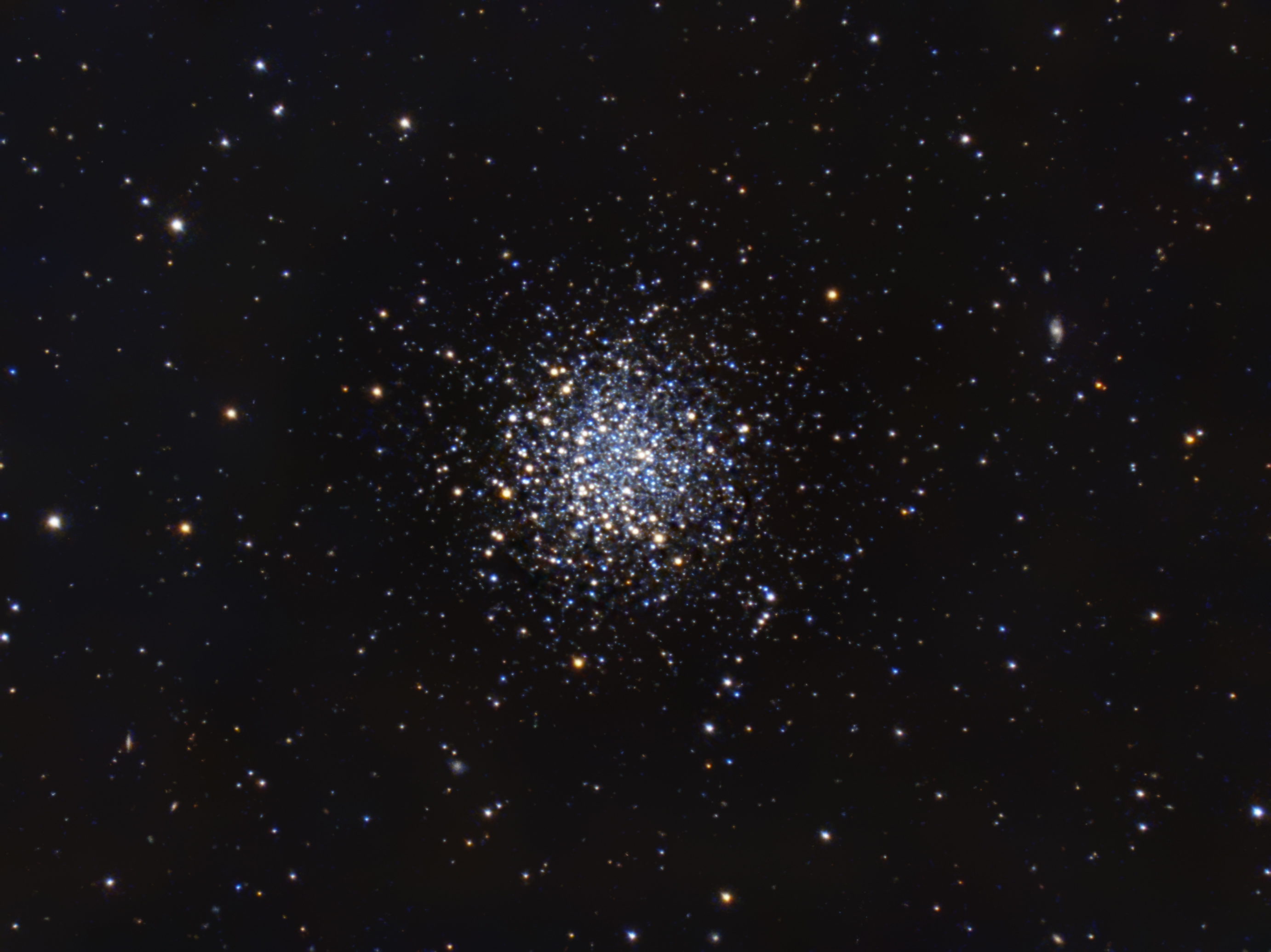
NGC 5466 - Mel 124 - Snowglobe Cluster (Ghost Globular Cluster)

NGC 5466 is a globular cluster located 51,800 light-years from Earth in the constellation Bootes. It is extremely old at approximately 12.5 billion years. It has an unusually sparse core and happens to be the same distance from the center of the Milky Way as it is from us. I did not find a whole lot of general information on this cluster but one interesting thing stands out is that it has a linear branch of blue stars running through it. Also the majority of the stars are metal poor compared to other globular clusters.

I imaged this because I did not want to waste another rare clear night just because the moon was out so I went for something that a moon would not wash out much. I did not crop this much because the field of view contained many smaller galaxies, some of which show a bit of structure. My favorite is PCG 50187, the one on the right side of the image. I was also surprised and happy with the colors in starfield as well as within the cluster.  


NGC 5466 - Mel 124 - Snowglobe Cluster (Ghost Globular Cluster)
Dates: 5-12-22
Camera: ZWO ASI294MC-Pro
Telescope: Celestron EdgeHD 800
Barlow: None
Focal Length: 2032mm (native)
F/10 (native)
Focal Reducer: Celestron 0.7 Reducer Lens
Mount: Orion Atlas Pro
Filter Adaptor: ZWO Filter Drawer
Filter: Baader Moon and Skyglow (2-inch)
Focuser: ZWO EAF
Autoguiding: ASI120 Mini attached to an Orion ST80
Exposure: Lum 180 x 60
Gain: 139
Offset 0
Temp: -10 C
Processing: Asiair app, PixInsight, Photoshop, StarXTerminator, GradientXTerminator, Topaz DeNoiseAI.

https://www.instagram.com/astroquest1/
http://astroquest1.blogspot.com/
https://www.astrobin.com/users/kurtzepp/collections/
http://youtube.com/c/AstroQuest1