Showing posts with label French. Show all posts

Monday, April 1, 2013


Phlogiston is Finally Put to Rest by Lavoisier

APRIL 2013
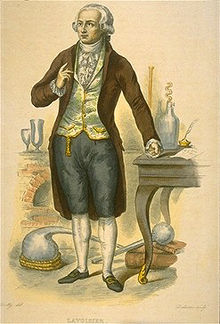
Antoine Lavoisier was a French chemist (1743-1494) who became known as “The Father of Modern Chemistry” with good reason.  He named  oxygen and hydrogen, predicted silicon, helped construct the metric system, and discovered that sulfur was an element rather than a compound to name a few of his achievements.  In one of his more famous experiments, he burnt phosphorus and sulfur in air, and showed that the products although they weighed more than the original, the weight gained was lost from the air, thus establishing the Law of Conservation of Mass.

What about the Phlogiston theory which postulated that materials released a substance called phlogiston when they burned first described in 1667?  The theory was an attempt to explain combustion and rusting and was accepted by most of the scientists of the time.  However, Lavoisier demonstrated the correct role of oxygen in the rusting process as well in respiration. Along with Pierre-Simon Laplace, Lavoisier conducted experiments that showed that respiration was essentially a slow combustion of organic material using inhaled oxygen.  In other words, he disproved the release of phlogiston.

At the age of 28, Lavoisier married 13-year-old Marie-Anne Pierrette Paulze who translated from English to French for him and illustrated his books.  Unfortunately for Lavoisier he was essentially a tax collector for the king during the French Revolution and was tried, convicted, and guillotined on 8 May in Paris, at the age of 50.    

sources:
ScienceWorld: Lavoisier

Tuesday, January 1, 2013

Uncle Amedeo!

JANUARY 2012
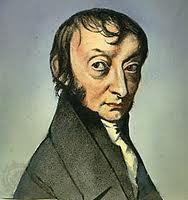
Amedeo Avogadro was (1776-1856) was an Italian scientist who was born in Turin.  He came from a well-to-do family of lawyers and became a lawyer himself.  However, he was more interested in natural sciences and in 1800 began studying physics and math.  In 1809 began teaching science in high school in Vercelli.  In 1811, during his teaching teaching tenure he published an article which contains probably his most famous contribution to science aptly named Avogadro's law (a.k.a. Avogadro’s hypothesis).  In a nutshell, he proposed that the volume of a gas (at a given pressure and temperature) is proportional to the number of atoms or molecules regardless of the nature of the gas.

The number of particles in one mole of substance, 6.02 x 10²³ , is known as Avogadro’s number in his honor and was never actually calculated by Avogadro due in part to the technology of the time but his understanding made it possible for later scientists to calculate it.  A rudimentary estimate was first proposed by Johann Josef Loschmidt in 1865 but was not measured accurately until 1909 by French physicist Jean Perrin

Avogadro's private life seems to be a mystery or at least scandal free.  He married Felicita MazzĂ© and had six children.  It has been suggested that he sponsored some Sardinian revolutionaries, who were eventually stopped by the announcement of Charles Albert's constitution in 1848.  Also, I have been unable to disprove the claim from my chemistry colleague, Antonio Ciccone (also from Italy), who keeps telling his students that Avogadro was his uncle.

sources:
chemistry.about.com
wikipedia: Amedeo Avogadro