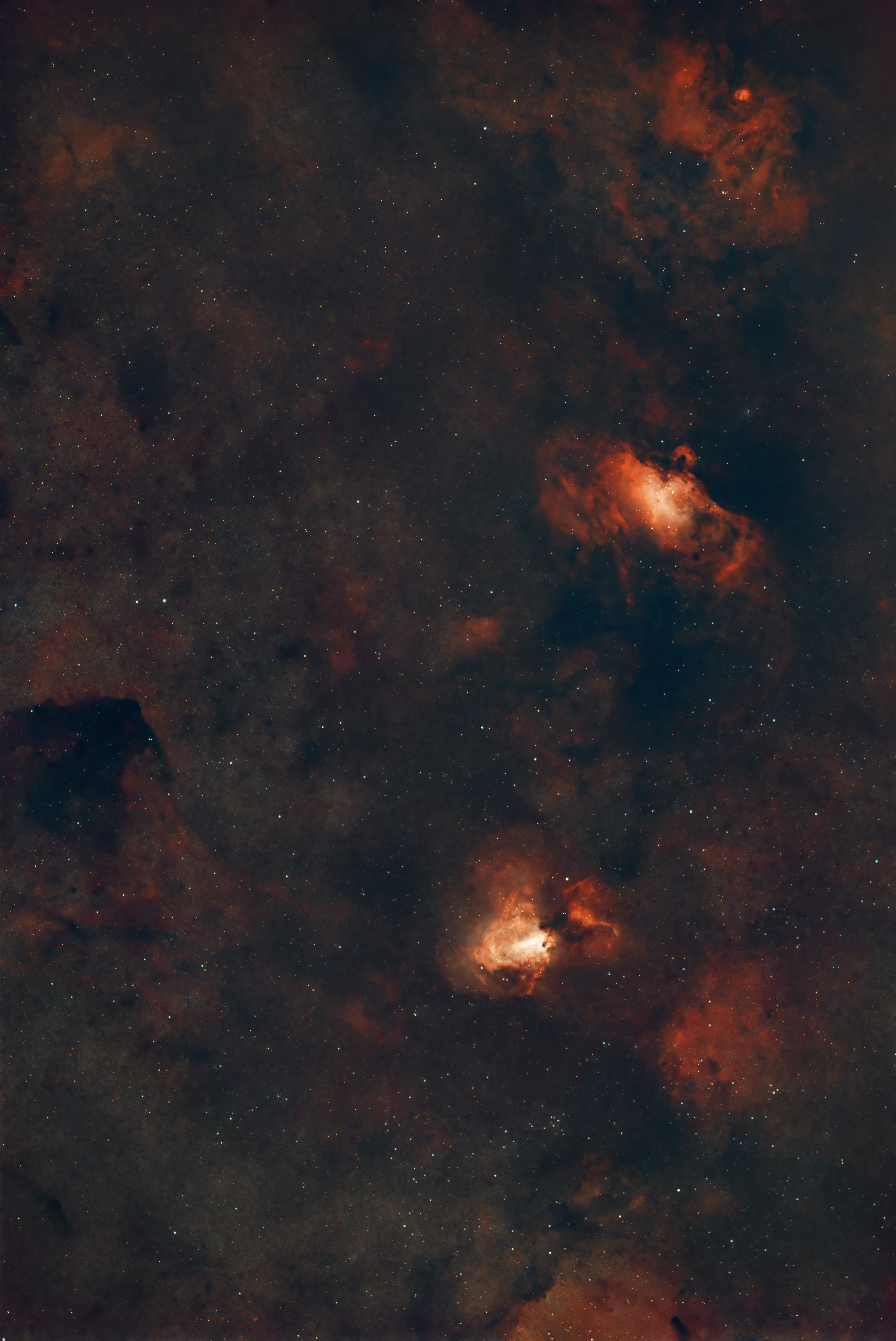
The framing is not a mistake, it is centered on HB3 (a.k.a. G132.7+1.3). HB3 is a Supernova Remnant (SNR) first cataloged by a radio astronomer and imaged optically in February of 2022 by a research group (article from the Royal Astronomical Society, https://arxiv.org/abs/2202.07749v1). I first found out about this object from Göran Nilsson who produces incredible images using his dual RASA rig from Värmland, Sweden (https://www.astrobin.com/96arhu/B/). According to the authors of the article, the SNR formed in a wind bubble cavity created by the progenitor star. The estimated mass of this Wolf-Rayet star is 34 solar masses.
As can be seen on the image the blue OIII structures from SNR are visible, however, they were quite difficult to bring out even with the over 20 hours of data. A starless version is most certainly needed in order to bring it out and fortunately many good star removal programs are available these days. Even so, it was still very difficult to process, in fact after one day of processing, I did not like what was produced and started over. In addition to the Heart Nebula, several other dark nebulae are scattered throughout the image including some on the right side. I cropped it only a small amount as I wanted to show the rest of the field including Segin, the bright blue star in Cassiopeia. I was hoping it would be more strongly visible but then again none of the SNR was visible in any of the 5-minute exposures.
As can be seen on the image the blue OIII structures from SNR are visible, however, they were quite difficult to bring out even with the over 20 hours of data. A starless version is most certainly needed in order to bring it out and fortunately many good star removal programs are available these days. Even so, it was still very difficult to process, in fact after one day of processing, I did not like what was produced and started over. In addition to the Heart Nebula, several other dark nebulae are scattered throughout the image including some on the right side. I cropped it only a small amount as I wanted to show the rest of the field including Segin, the bright blue star in Cassiopeia. I was hoping it would be more strongly visible but then again none of the SNR was visible in any of the 5-minute exposures.
If you do go after this object be prepared to get a lot of data and even then it is a bit iffy. On the positive side even if you don't get HB3, you will still get a decent image of the Heart Nebula. I have several images of the Heart Nebula that I have taken over the years so I did not mind not having it be the center of attention.

Dates: 8-23-22, 8-26-22, 8-29-22, 8-31-22, 9-1-22, 9-2-22
Camera: ZWO ASI2600MC-Pro
Telescope: Canon EF 200mm f/2.8L II USM Lens
Barlow: None
Focal Length: 200mm
f/4 with stepdown rings
Focal Reducer: None
Mount: Orion Atlas Pro
Filter Wheel/Drawer: ZWO EOS Filter Drawer
Filter: IDAS Nebula Booster NBZ Filter
Focuser: None
Autoguiding: ASI120 Mini attached to a ZWO Mini 30/120mm Guidescope
Exposure: 250 x 300
Gain: 100
Sensor Temp: 0 C
Processing: ASIAIR Pro, PixInsight, Photoshop, StarXTerminator.
Power: BINZET AC to DC 12V 10A 120W Power Supply
https://www.instagram.com/astroquest1/
http://astroquest1.blogspot.com/
https://www.astrobin.com/users/kurtzepp/collections/
http://youtube.com/c/AstroQuest1