This year's home chemistry experiment is an India Pale Ale (IPA). The first part was a success but I won't know how it really turned out until fermentation process is complete in a few weeks. Also, I had a little helper who says he loves making beer, at least until he gets bored...
Tuesday, July 2, 2013
The New Summer Brew
This year's home chemistry experiment is an India Pale Ale (IPA). The first part was a success but I won't know how it really turned out until fermentation process is complete in a few weeks. Also, I had a little helper who says he loves making beer, at least until he gets bored...
Friday, June 28, 2013
Tuesday, June 4, 2013
The Blog of Phyz: NGSS high school physical science breakdown: Take ...
The Blog of Phyz: NGSS high school physical science breakdown: Take ...: The Next Generation Science Standards (NGSS) have now been finalized. I would be surprised if California did anything other than to adopt t...
Adding to Dean Baird's
informative post with regard Next Generation Science Standards (NGSS), Connecticut, in particular Seymour High School (SHS), is in the process of reviewing these Science Standards in all likelihood, will adopt them. However, there will be some challenges that our department and other's will face.
For example, one thing that has not been addressed yet is whether next year's 10th Graders will take the current Connecticut Academic Performance Test (CAPT) or simply wait until they are in 11th Grade and just take the new NGSS Test.
Also, because of additional content or Performance Expectations (i.e. Earth Science, Space Science, and Environmental Science which have been incorporated into Life Science and Earth and Space Science Core Ideas) significant changes in course offerings and/or course content will have to occur. This is not a bad thing, however, especially since Earth and Space Science are back after being removed by the wisdom of the CAPT originators.
We have finished comparing our current science course offerings with the Skills and Content of the NGSS in order to identify deficiencies. Of course there were many areas which need modification and I am not sure how the robust nature of the Skills and Content will be addressed properly before the end of a student's Junior year in High School.
Stay tuned for more when ever we know more...
Saturday, June 1, 2013
Who Said Geography First
JUNE 2013
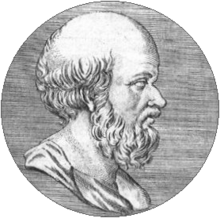
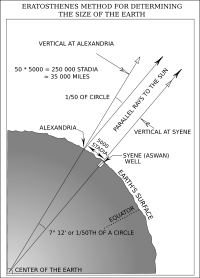
I’ve always liked Eratosthenes since I first heard about his accomplishments from Carl Sagan while watching Cosmos. Eratosthenes was Greek scholar born in Cyrene (276 BC) which is located in present day Libya and died in Alexandria (194 BC), the capital of Egypt during this time. He was educated in Athens and appointed as the third Chief Librarian of the Great Library of Alexandria in 240 BC. While at the library he wrote a book about the world, called geography, and introduced the climatic concepts of torrid, temperate, and frigid zones. He is most famous for calculating the circumference of the earth by comparing the angle of the shadow of the sun at summer solstice noon at Alexandria and Syene (directly south), and knowing the distance between the two, he calculated Earth is 250 000 stadia (~25 000 miles or 40 000 km).
(note: the diagram incorrectly lists 35 000 Miles)
Other claims of fame include calculating the tilt of Earth’s axis at 23.4ยบ and possibly the distance to the sun. He also created the first world map incorporating latitude and longitude. Finally, he along with his friend, Archimedes, made several contributions to mathematics including the Sieve of Eratosthenes which is a simple algorithm that determines prime numbers. One of Eratosthenes philosophical beliefs was that there was good and bad in all nations and criticized Aristotle for arguing that Greeks are better and should keep themselves racially pure.
sources:
About: EratosthenesWednesday, May 1, 2013
James Hutton - The Great Observer - This Doc Rocks
MAY 2013
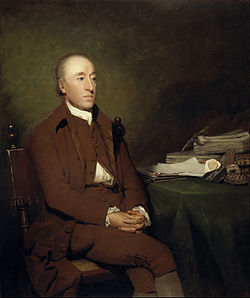
James Hutton was born in Edinburgh Scotland, in 1726 and died in 1797. He was interested in Mathematics and Chemistry from a young age. At age 17 he apprenticed with a lawyer (I guess he wanted to try something else) but was more interested in doing chemical experiments thus became a physician’s assistant. Eventually he earned a Doctor of Medicine degree at Leyden in 1749. After getting his degree, Hutton moved to Berwickshire farms, inherited from his father in 1713, where he performed more chemical experiments and introduced new farming practices. It is here that he became interested in studying the earth.
In 1768 Hutton moved back to Edinburgh and began making some of the most profound hypotheses of Earth’s structure using his extraordinary observational powers. He described the formation of sedimentary rock and deduced how granite penetrations in metamorphic schist were younger and intruded into it in a molten state. He also came up with the Theory of Uniformitarianism - geological forces at work in the present day are the same as those that operated in the past. Proposed internal heat and pressure within Earth formed igneous rocks, causes stratified layers to be tilted, and made mountains rise. Hutton made numerous other contributions in in the fields of geology, meteorology, and the development of evolution among others. Of course not everybody was not on board with his thinking especially since he described an Earth that far older than the 6,000 year old Earth as described by Bishop Ussher.
sources:
Profile: HuttonMonday, April 22, 2013
That Which Sparkles
| Figure 1 |
Lately, while taking my dog on one her numerous walks, I have been noticing an increase in the sparkles on the the side of the road and on the lawn near the road. Notice the center of figure 1. There has always been a few of these tiny shiny fragments but not this much. Even when I walked her in the dark with my headlamp, the reflection was quite impressive. My hypothesis is the town has a new source for their winter salt-sand mixture, one that has a high mica content, or more specifically muscovite (the mineral responsible for the sparkles). Of course to check this I would have to contact the town and they might think I am nutcase and also who has the time for that.
Muscovite, (KAl2(AlSi3O10)(F,OH)2) is a soft, platey, silicate mineral common in granitic type rocks. Flat, sheet, or platy silicate minerals are classified as phyllosilicates. Muscovite is colorless but can be lightly shaded green, brown, yellow, or even red unlike the other main mica, biotite (K(Mg,Fe)3AlSi3O10(F,OH)2), which is dark or black. Notice Figure 2 on my son's hand.
| Figure 2 |
| Figure 3 |
Monday, April 1, 2013
Phlogiston is Finally Put to Rest by Lavoisier
APRIL 2013
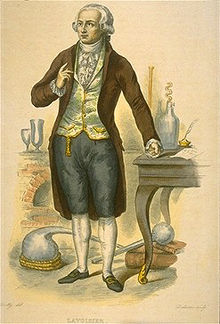
Antoine Lavoisier was a French chemist (1743-1494) who became known as “The Father of Modern Chemistry” with good reason. He named oxygen and hydrogen, predicted silicon, helped construct the metric system, and discovered that sulfur was an element rather than a compound to name a few of his achievements. In one of his more famous experiments, he burnt phosphorus and sulfur in air, and showed that the products although they weighed more than the original, the weight gained was lost from the air, thus establishing the Law of Conservation of Mass.
What about the Phlogiston theory which postulated that materials released a substance called phlogiston when they burned first described in 1667? The theory was an attempt to explain combustion and rusting and was accepted by most of the scientists of the time. However, Lavoisier demonstrated the correct role of oxygen in the rusting process as well in respiration. Along with Pierre-Simon Laplace, Lavoisier conducted experiments that showed that respiration was essentially a slow combustion of organic material using inhaled oxygen. In other words, he disproved the release of phlogiston.
At the age of 28, Lavoisier married 13-year-old Marie-Anne Pierrette Paulze who translated from English to French for him and illustrated his books. Unfortunately for Lavoisier he was essentially a tax collector for the king during the French Revolution and was tried, convicted, and guillotined on 8 May in Paris, at the age of 50.
sources:
ScienceWorld: Lavoisier
Subscribe to:
Posts (Atom)