Thursday, April 13, 2023

Venus, Pleiades, & Lens Flare (Oops)?

So my wife and I were vacationing in Santa Fe staying with her sister and brother-in-law whose house happens to border Santa Fe National Forest. I brought my wide angle portable setup and saw that Venus was very close to M45, The Pleiades Cluster, and decided to see if I could get a decent image before it went behind a tree. I did have the 200mm Canon Lens but not the counter weight for the iOptron Skyguider Pro or guidescope so exposures would have to be limited to 15 seconds. I managed to get twenty seven exposures which correlates to six minutes and forty five seconds so I was not expecting much but when I looked at the raw data on the computer I saw what looked like a small comet.

I did some checking but could not find any information about a comet in this region. In addition, the amount of movement in the almost seven minutes seemed fast (approximately 0.8 degrees in 6-minutes). Another thought I had was a meteor but it would be too slow for it to be that. Lastly, if you look closely, the object appears as three broken fragments but I am not positive of this as the single exposures show it as one unit. If this is the case then the breakup may be just an artifact from the comet Alignment function in PixInsight.

As expected, with such a small amount of exposure time, the noise level was quite high and there were gradients especially since I did not use any flats. Because of this I had to do a lot of processing gymnastics. Before realizing there was a comet or whatever it is, I thought this was going to be an easy object to process.

If anyone has any idea what this is please let me know in the comments. I have also attached it as a video animation (https://www.youtube.com/watch?v=6zgiMmfDuAE).

Date & Time:
10-April-2023, 9:27-9:42pm MDT

Addendum:
The Figure 1 is starting image and Figure 2 is the image from 15 minutes later. Venus does move a bit but not corrosponding to the unknown thing (reflection). Although maybe that is all that is needed.


Figure 1 - Start

Figure 2 - End

Venus, Pleiades, & Something? 
Dates: 4-10-23
Camera: Canon T3i/600d modified
Telescope: Canon EF 200mm f/2.8L II USM Lens
Barlow: None
Focal Length: 200mm
f/4 with stepdown rings
Focal Reducer: None
Mount: iOptron Skyguider Pro
Filter Wheel/Drawer: none
Filter: none
Focuser: none
Autoguiding: none
Exposure: 27 x 15
Gain/ISO: 1600
Processing: ASIAIR Pro, PixInsight, Photoshop, StarXTerminator, NoiseXTerminator, GHS,
GradientXTerminator, BTX.

https://www.instagram.com/astroquest1/
http://astroquest1.blogspot.com/
https://www.astrobin.com/users/kurtzepp/collections/
http://youtube.com/AstroQuest1

Wednesday, April 5, 2023

NGC 3227 & NGC 3226 - Arp 94

This rather odd looking object in the center is a large intermediate spiral, NGC 3227, that is interacting with a dwarf elliptical galaxy, NGC 3226. Intermediate refers to it being between a barred and unbarred spiral galaxy. Together these cosmic tidal dance partners are known as Arp 94 and are approximately 60 million light-years away in the constellation Leo.

NGC 3227 is a Seyfert galaxy which means it has an active galactic nucleus and releases huge amounts of energy in the form of X-rays. As with most Seyfert galaxies which contain black holes, this one has a supermassive black hole in its core.

I really like the very distorted outer regions of the interacting galaxies and also the flocculating structure near the core. There appears to be a dense lobe in the faint outer region on both sides which I am guessing may be drawfs or parts of arms torn off by tidal forces. Neither galaxy seems to show much color variation but I kind of like the golden color. The rest of the field is loaded with galaxies of all types and sizes although they all appear small since they are much further away. Some of these smaller galaxies appear to be in clusters. Some of the highlights are NGC 3222 located on the central right at approximately 178 million ly; PGC 3754953 located on the top at approximately 102 million ly; PGC 30397 and PGC 1065532 located on the lower right at approximately 120 million ly and are most likely interacting.

I imaged this over four nights, however, I only used two nights worth of data proving that less data is better - Ha Ha. Normally it would be a weather issue but what happened on the third night is more sinister. When the session was done I removed the dew shield and I noticed the corrector plate was covered in dew. My first thought was that the dew ring was broken, however, upon closer examination I saw that I never connected it! I know some of you imagers in certain regions probably don't know what a dew heater is but they are a necessity in the northeast. On the last night of imaging it appeared to be clear but the seeing was not good so I did not use it. Originally I started making an image using all the data after running Subframe Selector but after seeing how the image looked I stacked them night by night and saw the degradation. So out of the 307 total exposures, only 140 were used.

Another issue I had was a weird circular reflection which turned out to be from the bright star Algieba in Leo. I was able to do a bit of processing to get rid of it.


NGC 3227 & NGC 3226 - Arp 94 (2023)
Dates: 3-19-23, 3-19
Camera: ZWO ASI294MC-Pro
Telescope: Celestron EdgeHD 800
Barlow: None
Focal Length: 2032mm (native), 1400mm
F/10 (native), F/7
Focal Reducer: Celestron 0.7 Reducer Lens
Mount: Orion Atlas Pro
Filter Adaptor: ZWO Filter Drawer
Filter: Optolong Luminosity
Focuser: ZWO EAF
Autoguiding: ASI120 Mini attached to an Orion ST80
Exposure: Lum 140 x 90
Gain: 139
Offset 0
Temp: -10 C
Processing: Asiair app, PixInsight, Photoshop, BlurXT, NoiseXT, StarX

https://www.instagram.com/astroquest1/
http://astroquest1.blogspot.com/
https://www.astrobin.com/users/kurtzepp/collections/
http://youtube.com/AstroQuest1

Thursday, March 30, 2023

IC 410 reprocessed using the Colorized SHO Palette processing method

When imaging using narrowband filters such as hydrogen (Ha), oxygen (OIII), and sulfur (SII) in order bring out certain more detail in nebulae, the three separate filters are combined by putting the sulfur in the red band, the hydrogen in the green band, and oxygen in the blue band hence the SHO Palette (a.k.a. the Hubble Palette).

So shortly after processing this image using the traditional SHO Palette combination I happened to watch a video by Cuiv, The Lazy Geek (AMAZING Hubble Palette technique!) where he described a new SHO processing method developed by Steven Miller of Entering Into Space. Steve's video (Colorized SHO Palette NO MORE FIGHTING THE GREEN!) is very comprehensive and definitely worth a watch as is Cuiv's. The basic premises of this method is to colorize the Hydrogen, Sulfur, and Oxygen prior to combining them. The benefit of doing this eliminates the oversaturated green tint that typically is produced when combined. Additionally I learned a lot of new PisInsight tricks such as making masks with the ACDNR noise reduction function. 

Method Summary
Data from narrowband filters is gray so it is simply combined directly into the desired channel bands. The summarized version of using this method is as follows: First do your normal linear processing on each filtered band and then change each image from gray to RGB. Second, make the images nonlinear and equalize the backgrounds - I did this using EZ Soft Stretch which automatically stretches it and equalizes the background. Third, colorize the Ha to a gold color, the OIII to a deep blue color, and the sulfur to a red-yellow color. Lastly, the images are combined using PixelMath. The color combination selection in PixInsight will not work on RGB data.

Results
My normal narrowband processing in PI consists of cropping, dynamic background extraction, BlurX, StarX, EZ Stretch. After stretching the images (making them nonlinear), each filtered image was colorized using curves and then a bit of noise reduction was done using NoiseX. Figure 1 shows the final color of sulfur, Figure 2 shows the final color of oxygen, and Figure 3 shows the final color of hydrogen. 

The three separate images were then combined in PixelMath with SII in the red channel, Ha in the green channel, and OIII in the blue channel. Figure 4 shows the result of the combination. The image looked very colorful and there was very little green, however, there was a lot of magenta. To get rid of that I did an inverse SNCR. Figure 5 shows that result which is the more traditional look. Some additional processing was done in order to make the colors more vibrant and the RGB stars from the originally processed image were blended to make the final version (Figure 6). 

Figure 7 is the original image processed the traditional way a few weeks ago. I did some additional processing that I learned from Steve's video to make a second version of my original image (Figure 8). Since I liked certain aspects of both methods I decided to do a blend and produced a final image 
(Figure 9).  

Final Thoughts
1)    There is little green in the combined image , howere there may be other over bearing colors.
2)    There was more nebulosity in the combined image and it seemed to be more vibrant.
3)    The colors may be highly subjective depending how the colorization is done.
4)    The method seems to work and hope to try it out again.

Figure 1 - Colorized Sulfur (Yellow-Red)

Figure 2 - Colorized Oxygen (Blue)

Figure 3 - Colorized Hydrogen (Gold)

Figure 4 - Combined SHO 


Figure 5 - Combined SHO after inverse SNCR

Figure 6 - Colorized SHO Palette


Figure 7 - Original Hubble Palette SHO Image

Figure 8 - Original SHO Image with Entering Into Space Enhanncements 

Figure 9 - Blended Image (Fig. 6 and Fig. 8)

IC 410 - Tadpoles (2023)
Dates: 12-29-22, 1-9-23, 16, 18, 24, 2-6, 8, 10, 11, 14, 15, 18
Camera: ZWO ASI1600MM-Pro
Telescope: Astro-Tech AT115EDT 115mm Refractor Telescope
Barlow: None
Focal Length: 805mm (644mm w/ FR)
f/7
Focal Reducer: 0.8x AstroTech Field Flatterner/Focal Reducer
Mount: Orion Sirius
Filter Wheel: ZWO
EFW 8 x 1.25"
Filter: Antlia Ha, OIII; ZWO R, G, B, SII
Focuser: ZWO EAF
Autoguiding: ASI120 Mini attached to an Agena 50mm Guide Scope/ZWO 60mm Guidescope
Exposure: Ha 101 x 300, OIII 94 x 300, SII 77 x 300, R 30 x 60, G 29 x 60, B 37 x 60
Gain: 139
Offset 20
Sensor Temp: -20 C
Processing: NINA, PixInsight, Photoshop, BlurXTerminator, StarXTerminator, NoiseXTerminator, Bill Blanshan Masks.

https://www.instagram.com/astroquest1/
http://astroquest1.blogspot.com/
https://www.astrobin.com/users/kurtzepp/collections/
http://youtube.com/AstroQuest1

Saturday, March 25, 2023

M35 & NGC 2158 (2023)

The main cluster in this image is Messier 35 or M35, also known as NGC 2168. It is a relatively close open cluster approximately 3,000 light-years away in Gemini. It contains many bright blue stars like many other open clusters which indicate that it is relatively young at 175 million years. My only other image of this wonderful cluster was an uninspiring image from January of 2016 (https://astroquest1.smugmug.com/Messier-Objects/i-T7XcKk4/A). I only imaged it this time because I was waiting for my planned target to get above the trees - I am really glad I did. I don't know why I have been skipping these gorgeous objects, possibly because when I did it seven years ago it was plain looking.

I did not center this on M35 because I wanted to capture NGC 2158 located directly southwest in the lower right side of the image. NGC 2158 is also an open cluster, only much tighter. In addition it is much further at 11,000 light-years away and much older at two billion years.

It was such a pleasure to process something like this rather than a nebula or galaxy. These types of objects have another benefit in that they do not need super long exposure times and can be imaged with a little moonlight although this was done when it was moonless.


M35 & NGC 2158 (2023)
Dates: 3-19-23, 3-20
Camera: ZWO ASI294MC-Pro
Telescope: Celestron EdgeHD 800
Barlow: None
Focal Length: 2032mm (native), 1400mm
F/10 (native), F/7
Focal Reducer: Celestron 0.7 Reducer Lens
Mount: Orion Atlas Pro
Filter Adaptor: ZWO Filter Drawer
Filter: Optolong Luminosity
Focuser: ZWO EAF
Autoguiding: ASI120 Mini attached to an Orion ST80
Exposure: Lum 153 x 90
Gain: 139
Offset 0
Temp: -10 C
Processing: Asiair app, PixInsight, Photoshop, BlurXT, NoiseXT

https://www.instagram.com/astroquest1/
http://astroquest1.blogspot.com/
https://www.astrobin.com/users/kurtzepp/collections/
http://youtube.com/AstroQuest1

Wednesday, March 15, 2023

Sh2-261 - Lower's Nebula (2023)

This colorful object image is a portion of Lower's Nebula or SH2-261. The nebula is a hydrogen alpha (Ha) region about 3,200 light-years away in Orion, specifically where the hand meets the club. It is named after amateur astronomer Harold Lower and his son Charles who discovered this nebula in 1939 in their home of San Diego. The nebula is located on the outermost edge of the Milky way galaxy, on the border of the galactic region between the Orion and Perseus arm.

There was no pre-planning on this object as I quickly was looking for something available to image in my FOV with the Edge800 in preparation for galaxy season. The weather has not been kind lately and for whatever reason the data had heavy gradients possibly due to weather, imaging with the moon, old flats, or all three. I did not make a fresh set of flats and using the ZWO ASI294 MC with dual band filters which isolate hydrogen is problematic anyway - the SONY IMX294CJK has some type of film on it that shows up when using Ha filters. It is usually subtracted out by the flats but the flats have to be really good.

Since I did not get the whole nebula because it is very large anyway, I cropped it around one of my favorite parts, the lower portion, and got rid of some of the gradients in the process. The lower portion where the gas seems to be concentrated most and it has the sharpest detail. I was happy the stars came out OK especially since SCTs are more fussy than refractors (some people would find these stars unacceptable). Of course when I actually get around to imaging galaxies a new set of flats will be made.


Sh2-261 - Lower's Nebula (2023)
Dates: 2-15-23, 2-18, 2-24, 2-26, 3-8
Camera: ZWO ASI294MC-Pro
Telescope: Celestron EdgeHD 800
Barlow: None
Focal Length: 2032mm (native), 1400mm
F/10 (native), F/7
Focal Reducer: Celestron 0.7 Reducer Lens
Mount: Orion Atlas Pro
Filter Adaptor: ZWO Filter Drawer
Filter: IDAS NBZ
Focuser: ZWO EAF
Autoguiding: ASI120 Mini attached to an Orion ST80
Exposure: IDAS NBZ 273 x 180
Gain: 139
Offset 0
Temp: -10 C
Processing: Asiair app, PixInsight, Photoshop, StarXTerminator, BlurXT, NoiseXT, GHS, Bill's Star Reduction, Bill's Color Masks.

https://www.instagram.com/astroquest1/
http://astroquest1.blogspot.com/
https://www.astrobin.com/users/kurtzepp/collections/
http://youtube.com/AstroQuest1

Tuesday, February 28, 2023

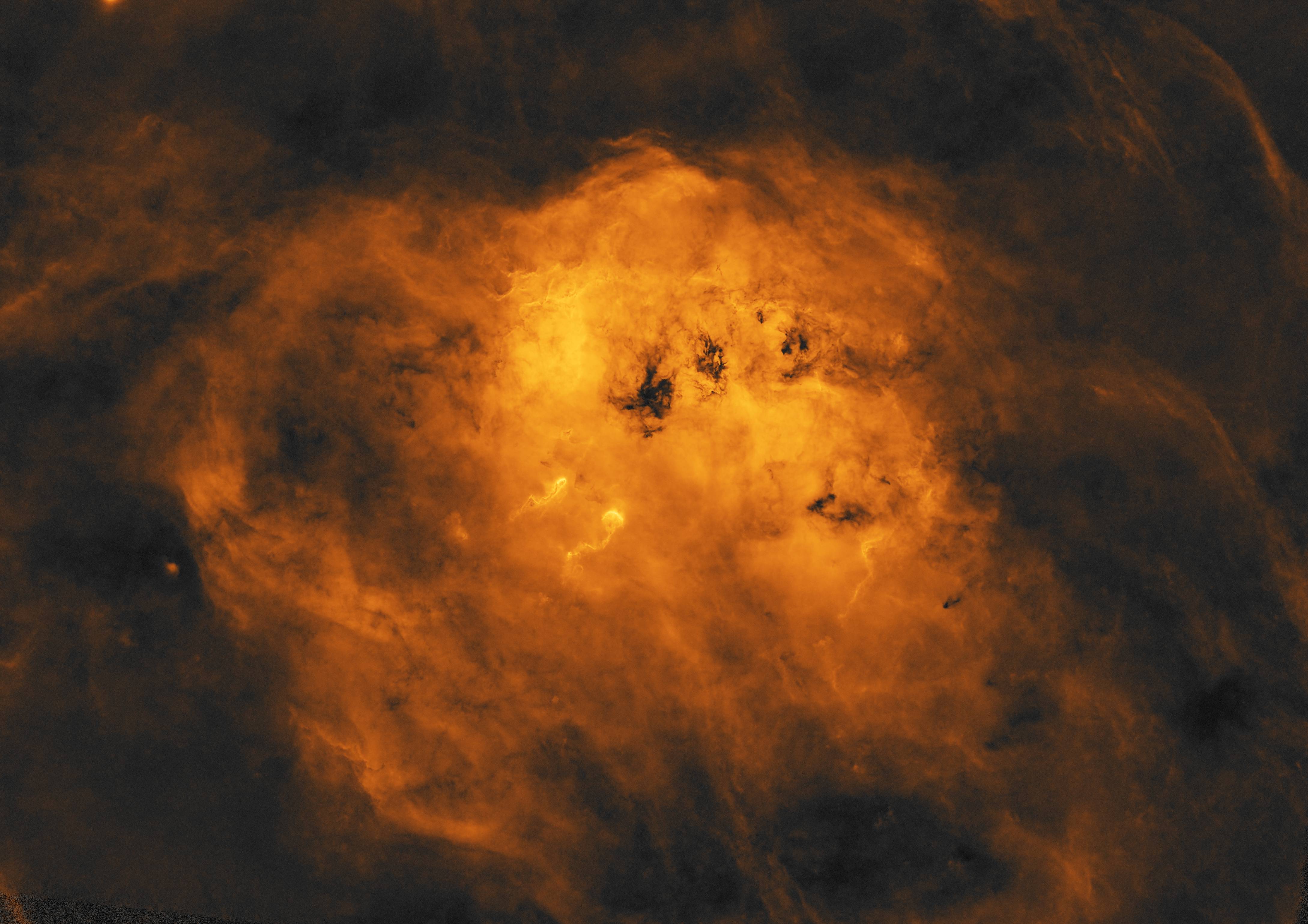
IC 410 - Tadpoles (2023)

IC 410, nicknamed the Tadpole Nebula, is located 12,000 light-years away in the constellation of Auriga. Two particularly thick dense streams of gas and dust that resemble tadpoles are the highlight of this region and over 10 light-years across. In addition they are a likely source of star formation. The entire region is over 100 light-years across and strong stellar winds have carved and sculpted it into its present shape. These stellar winds originate from open cluster NGC 1893 which is also supplying the energy that is ionizing the nebula gases.

The tadpoles really do look like they are swimming towards the cluster at the edge of the dark region and I find them incredible to look at. This is my second attempt at this object, my first was a not so impressive image from over three years ago - https://www.astrobin.com/qa21lp/?nc=collection&nce=701. This version is far superior in many ways and I am glad I revisited it. Other parts such as the fine detail around the dark central area and the golden-red edges are equally as fascinating to me as the tadpoles themselves.

I did crop this a bit but not as much as I could have because there was more faint nebulosity in the background than I expected and I wanted to keep it. On the other hand I did crop it some because I wanted to highlight the finer detail on the tadpoles and central area.

So why was this image so improved from my previous attempt? By far it was new filters! I upgraded my good & dependable 7nm narrowband OIII & Ha filters for 3nm Antlia Pro filters. I originally planned just to upgrade the OIII filter but liked the results so much I ordered the Ha the next day (I will upgrade the SII as soon as funds become available). The narrower band pass allows for a much better or more specific signal so images are much more detailed. In addition, the well known halos around bright stars using OIII filters were completely eliminated with this filter. One of the benefits of having an 8-position filter wheel is the ability to use the empty filter try for same night experimenting which is exactly what I did. I made a couple of videos comparing the 7nm vs. the 3nm filters:


Dates: 12-29-22, 1-9-23, 16, 18, 24, 2-6, 8, 10, 11, 14, 15, 18
  
https://www.instagram.com/astroquest1/
http://astroquest1.blogspot.com/
https://www.astrobin.com/users/kurtzepp/collections/
http://youtube.com/AstroQuest1


IC 410 - Tadpoles (2023)
Dates: 12-29-22, 1-9-23, 16, 18, 24, 2-6, 8, 10, 11, 14, 15, 18
Camera: ZWO ASI1600MM-Pro
Telescope: Astro-Tech AT115EDT 115mm Refractor Telescope
Barlow: None
Focal Length: 805mm (644mm w/ FR)
f/7
Focal Reducer: 0.8x AstroTech Field Flatterner/Focal Reducer
Mount: Orion Sirius
Filter Wheel: ZWO 
EFW 8 x 1.25"
Filter: Antlia Ha, OIII; ZWO R, G, B, SII
Focuser: ZWO EAF
Autoguiding: ASI120 Mini attached to an Agena 50mm Guide Scope/ZWO 60mm Guidescope
Exposure: Ha 101 x 300, OIII 94 x 300, SII 77 x 300, R 30 x 60, G 29 x 60, B 37 x 60
Gain: 139
Offset 20
Sensor Temp: -20 C
Processing: NINA, PixInsight, Photoshop, BlurXTerminator, StarXTerminator, NoiseXTerminator, Bill Blanshan Masks.

https://www.instagram.com/astroquest1/
http://astroquest1.blogspot.com/
https://www.astrobin.com/users/kurtzepp/collections/
http://youtube.com/AstroQuest1

Monday, February 20, 2023

Sh2-240 - The Camera Killer? (in my case)

Sh2-240 also goes by Simeis 147 or The Spaghetti Nebula but not The Camera Killer - I'll get to that a bit later. It is a very faint supernova remnant (SNR) approximately 3,000 light-years away on the boundary of the constellations of Auriga and Taurus. In addition to being faint, it is very large at 150 light-years across taking up 3 degrees of arc which corresponds to six full moons. This supernova event that made this nebula is believed to have occurred 40,000 years ago.

The fine twisty ropey filaments that make up this gorgeous looking object make this a popular target for amateurs and professionals alike. The deep reds from ionized hydrogen and blue-greens from ionized oxygen are really just incredible. All that remains from this catastrophic explosion is a fast-spinning neutron star (a.k.a. pulsar). These are some of the most dense things in the universe (a spoonful would weigh a billion tones).

I have wanted to image this for many years now but always held off for one reason or another - mainly equipment and processing skill. With my widefield setup consisting of the 200mm Canon Lens, ZWO ASI2600MC Pro, IDAS NBZ filter, and Orion Atlas Pro I was ready - I was planning to get 25 or 30 hours. I started in early January 2023 with a couple partial nights and that was it. Crappy weather for the rest of January except when the moon was in the direction of the nebula or directly behind it. By the time the moon went away, the clouds came back. This nonsense went on halfway through February when we finally had some clear nights. I managed to get another decent night for a total of 14 hours to date. No problem as more clear weather was on its way and I finally should be able to get my desired 30 hours of exposure, right?
 
Now for the name...If you follow me on FB or YouTube you already know what happened:

The Bad News: So my beloved ZWO ASI2600MC Pro developed the dreaded silicon grease leak.
The Good News: Both ZWO and Agena Astroproducts were very helpful, supportive, and are taking care of the problem.

I made a video which shows what the leak looked on my sensor:

I made the best out of the 12 hours of data I had and believe it came out fine - just wish I was able to get close to what I planned on.


Sh2-240 - The Camera Killer? (in my case)
Dates: 1-16-23, 1-18, 1-24, 2-6, 2-8, 2-11, 2-18 
Camera: ZWO ASI2600MC-Pro
Telescope: Canon EF 200mm f/2.8L II USM Lens
Barlow: None
Focal Length: 200mm
f/4 with stepdown rings
Focal Reducer: None
Mount: Orion Atlas Pro
Filter Wheel/Drawer: ZWO EOS Filter Drawer
Filter: IDAS Nebula Booster NBZ Filter
Focuser: None
Autoguiding: ASI120 Mini attached to a ZWO Mini 30/120mm Guidescope
Exposure: 162 x 300
Gain: 100
Sensor Temp: -20 C
Processing: ASIAIR Pro, PixInsight, Photoshop, StarXTerminator, NoiseXTerminator, GHS,
GradientXTerminator, BTX, Bill's Star Reduction, Bill's Color Mask Tools.
Power: BINZET AC to DC 12V 10A 120W Power Supply

https://www.instagram.com/astroquest1/
http://astroquest1.blogspot.com/
https://www.astrobin.com/users/kurtzepp/collections/
http://youtube.com/AstroQuest1