Sunday, September 25, 2022

Sh2-91 - Part of a Large Supernova Remnant

Sharpless 91 (Sh2-91) is a portion of the large supernova remnant (SNR), SNR 065.2+05.7. Along with Sh2-94 and Sh2-96 they are all filaments of the SNR with a diameter of about 230 light-years (70 parsecs) and an age approximately 30,000 years. It is located in Cygnus very close to the Veil Nebula but further away at 2500 light-years (Ly) as opposed to 1500 Ly for the Veil and it is four times older. Also located in this image is the small Planetary Nebula Min 1-92 (Minkowski's Footprint). In my image it looks like a tiny blue elongated star roughly in the center left of the large blue star and just below the nebula (there is a white star next to it so they almost look like they could be a double star system). I really like the blue and red intertwining filamentary structure. I also like the colorful starfield that this nebula resides in, however, it is a double edge sword as those same stars really had to be reduced in order to bring out the nebula.

So this image represents my first attempt at doing a mosaic and it was by accident (?). What happened is I thought I had my camera oriented 90 degrees from and I did not realize it until after I started - this object is much dimmer than the Veil. After I got started I decided to go with the mosaic as even if I had the camera oriented differently I still would not have captured the whole thing. The mosaic is 3-planes oriented vertically and it was really easy to set up a plan for the other two planes in N.I.N.A. as all I had to do was adjust the right ascension. I did the mosaic processing in PixInsight following YouTube instructions from Windy City Astrophotgraphy (Nick). It worked well or so I thought when I first looked, however, when I removed the stars the merging was quite apparent. The good news is it was not so bad and I was able to do a little processing gymnastics to fix it. There is another program, Microsoft Image Composite Editor, that has been getting good reports so the next time I do a mosaic I might try it instead.

Dates: 8-1-22, 8-2, 8-3, 8-5, 8-6, 8-8, 8-12, 8-14, 8-18, 8-20, 8-23, 8-26, 8-27, 8-29, 8-31, 9-1, 9-2, 9-9

Exposure: 
Plane1 - Ha 51 x 300, OIII 61 x 300, R 55 x 60, G 51 x 60, B 50 x 60
Plane2 - Ha 53 x 300, OIII 46 x 300, R 39 x 60, G 41 x 60, B 40 x 60
Plane3 - Ha 49 x 300, OIII 68 x 300, R 32 x 60, G 37 x 60, B 37 x 60


Sh2-91 - Part of a Large Supernova Remnant (2022)
Dates: 8-1-22, 8-2, 8-3, 8-5, 8-6, 8-8, 8-12, 8-14, 8-18, 8-20, 8-23, 8-26, 8-27, 8-29, 8-31, 9-1, 9-2, 9-9
Camera: ZWO ASI1600MM-Pro
Telescope: Astro-Tech AT115EDT 115mm Refractor Telescope
Barlow: None
Focal Length: 805mm (644mm w/ FR)
f/7
Focal Reducer: 0.8x AstroTech Field Flatterner/Focal Reducer
Mount: Orion Sirius
Filter Wheel: ZWO EFW 8 x 1.25"
Filter: ZWO Ha, OIII, R, G, B
Focuser: ZWO EAF
Autoguiding: ASI120 Mini attached to an Agena 50mm Guide Scope/ZWO 60mm Guidescope
Exposure: 
Plane1 - Ha 51 x 300, OIII 61 x 300, R 55 x 60, G 51 x 60, B 50 x 60
Plane2 - Ha 53 x 300, OIII 46 x 300, R 39 x 60, G 41 x 60, B 40 x 60
Plane3 - Ha 49 x 300, OIII 68 x 300, R 32 x 60, G 37 x 60, B 37 x 60
Gain: 139
Offset 20
Sensor Temp: 0 C
Processing: NINA, PixInsight, Photoshop, Topaz DeNoiseAI, StarXTerminator.

https://www.instagram.com/astroquest1/
http://astroquest1.blogspot.com/
https://www.astrobin.com/users/kurtzepp/collections/
http://youtube.com/c/AstroQuest1

Thursday, September 8, 2022

HB3 - Supernova Remnant Next to the Heart Nebula!

The framing is not a mistake, it is centered on HB3 (a.k.a. G132.7+1.3). HB3 is a Supernova Remnant (SNR) first cataloged by a radio astronomer and imaged optically in February of 2022 by a research group (article from the Royal Astronomical Society, https://arxiv.org/abs/2202.07749v1). I first found out about this object from Göran Nilsson who produces incredible images using his dual RASA rig from Värmland, Sweden (https://www.astrobin.com/96arhu/B/). According to the authors of the article, the SNR formed in a wind bubble cavity created by the progenitor star. The estimated mass of this Wolf-Rayet star is 34 solar masses.

As can be seen on the image the blue OIII structures from SNR are visible, however, they were quite difficult to bring out even with the over 20 hours of data. A starless version is most certainly needed in order to bring it out and fortunately many good star removal programs are available these days. Even so, it was still very difficult to process, in fact after one day of processing, I did not like what was produced and started over. In addition to the Heart Nebula, several other dark nebulae are scattered throughout the image including some on the right side. I cropped it only a small amount as I wanted to show the rest of the field including Segin, the bright blue star in Cassiopeia. I was hoping it would be more strongly visible but then again none of the SNR was visible in any of the 5-minute exposures.

If you do go after this object be prepared to get a lot of data and even then it is a bit iffy. On the positive side even if you don't get HB3, you will still get a decent image of the Heart Nebula. I have several images of the Heart Nebula that I have taken over the years so I did not mind not having it be the center of attention.


HB3 - Supernova Remnant Next to the Heart Nebula!
Dates: 8-23-22, 8-26-22, 8-29-22, 8-31-22, 9-1-22, 9-2-22 
Camera: ZWO ASI2600MC-Pro
Telescope: Canon EF 200mm f/2.8L II USM Lens
Barlow: None
Focal Length: 200mm
f/4 with stepdown rings
Focal Reducer: None
Mount: Orion Atlas Pro
Filter Wheel/Drawer: ZWO EOS Filter Drawer
Filter: IDAS Nebula Booster NBZ Filter
Focuser: None
Autoguiding: ASI120 Mini attached to a ZWO Mini 30/120mm Guidescope
Exposure: 250 x 300
Gain: 100
Sensor Temp: 0 C
Processing: ASIAIR Pro, PixInsight, Photoshop, StarXTerminator.
Power: BINZET AC to DC 12V 10A 120W Power Supply

https://www.instagram.com/astroquest1/
http://astroquest1.blogspot.com/
https://www.astrobin.com/users/kurtzepp/collections/
http://youtube.com/c/AstroQuest1

Monday, August 29, 2022

WR 134 (HOO)

WR 134 is a star located in Cygnus approximately 6,000 light-years away. It is a special type known as a Wolf-Rayet star, which releases intense radiation and strong solar winds carrying its outer layers. The star (HD 191765) is the bright yellow star sitting between the two bright blue stars in the center of the nebula. The blue arc was produced when the radiation and particles from the outer layers collided with the ambient nebula already in the region. The blue oxygen rich region is strongest in the upper left portion where it forms the arc, it is visible surrounding the star forming a bubble.

I really love this region and will most likely be back with different equipment. Most objects have an optimal focal length (magnification + field of view) with what looks good, however, this object in particular looks good at many different focal lengths from 400mm to 1400mm which is what I used with the 0.7 focal reducer. I processed this emphasizing HOO, but again, there are many fantastic different versions out there.

As usual I would have loved to get more time on it especially since it was with a OSC camera, in fact I was out there many nights wading through supposedly clear nights, however, I am happy with the image. This is one object I would definitely put on anyone's to-do list who has an OIII filter since it can be imaged well with any telescope but you may need to block out some time as it is dim.


WR 134 (HOO)
Dates: 8-1, 8-2, 8-3, 8-6, 8-20
Camera: ZWO ASI294MC-Pro
Telescope: Celestron EdgeHD 800
Barlow: None
Focal Length: 2032mm (native), 1400mm
F/10 (native), F/7
Focal Reducer: Celestron 0.7 Reducer Lens
Mount: Orion Atlas Pro
Filter Adaptor: ZWO Filter Drawer
Filter: IDAS NBZ, Baader UV-IR
Focuser: ZWO EAF
Autoguiding: ASI120 Mini attached to an Orion ST80
Exposure: Baader UV-IR 66 x 90, NBZ 184 x 180
Gain: 139
Offset 0
Temp: 0 C
Processing: Asiair app, PixInsight, Photoshop, StarXTerminator, Topaz DeNoiseAI.

https://www.instagram.com/astroquest1/
http://astroquest1.blogspot.com/
https://www.astrobin.com/users/kurtzepp/collections/
http://youtube.com/c/AstroQuest1

Thursday, August 25, 2022

North America & Pelican Nebulae (IDAS NBZ Filter Test)

This is the North America Nebula (NGC 7000) and the Pelican Nebula (IC 5070) in the same frame. If you saw my previous post, I did this object with the Baader Neodymium (Moon & Skyglow) Filter and this image was done with the IDAS Nebula Booster NBZ Filter. As I stated last time, the filters are quite different in what they are designed for and the light they filter. The Baader Skyglow is a broadband filter which allows for most light to pass through but certain wavelengths commonly associated with streetlights are blocked. The IDAS NBZ is a dual narrowband filter that only allows for certain wavelengths (~500nm & 656nm) which correspond to Oxygen III (495.9nm & 500.7nm) and Hydrogen Alpha (656.3nm).


As expected, this version looks quite different from the Baader image. The overall color from the image using the NBZ filter is heavier in red which is due to its high abundance of hydrogen and the lighter colors scattered throughout are due to the oxygen. In addition to showing more of the nebulosity, the finer detail is much more apparent. This image shows fine strands and puffy clouds which are not always visible in the other image.

To process this image I separated the stacked image into red, green, and blue channels. The reason for this is because I wanted to create hydrogen (Ha) and oxygen (OIII) images out of the RGB. Since the hydrogen wavelength is in the red spectrum, the red band was used for Ha. The OIII wavelength is a little tricky as it mostly resides in the green-blue spectrum so I made the oxygen from a blend of 70% green and 30% blue - this combination is used because the oxygen band is mostly in the green band. I then combined the Ha in the red band and OIII in the green and blue bands making it an HOO image. The advantage is it gets rid of some unwanted noise and brings out a bit more detail.


North America & Pelican Nebulae (IDAS Nebula Booster NBZ Filter Test)
Dates: 8-18-22
Camera: ZWO ASI2600MC-Pro
Telescope: Canon EF 200mm f/2.8L II USM Lens
Barlow: None
Focal Length: 200mm
f/4 with stepdown rings
Focal Reducer: None
Mount: iOptron SkyGuider Pro
Filter Wheel/Drawer: ZWO EOS Filter Drawer
Filter: IDAS Nebula Booster NBZ Filter
Focuser: None
Autoguiding: ASI120 Mini attached to a ZWO Mini 30/120mm Guidescope
Exposure: 49 x 180
Gain: 100
Sensor Temp: 0 C
Processing: ASIAIR Pro, PixInsight, Photoshop, StarXTerminator.
Power: BINZET AC to DC 12V 10A 120W Power Supply

https://www.instagram.com/astroquest1/
http://astroquest1.blogspot.com/
https://www.astrobin.com/users/kurtzepp/collections/
http://youtube.com/c/AstroQuest1

Thursday, August 18, 2022

North America & Pelican Nebulae (Baader Neodymium Filter Test)

I have not imaged both the North America Nebula (NGC 7000) and the Pelican Nebula (IC 5070) in the same before so I figured this would be an excellent object to do some more testing. I wanted to compare the Baader Neodymium (Moon & Skyglow) Filter with the IDAS NBZ Filter so there will be another image using the NBZ once the weather permits and I image it. The filters are quite different in what they are designed for and light they filter out so it is not a comparison which is better but more about what each filter can do.

I am very impressed with this Skyglow Filter especially since it was done when the moon was up. There were some gradients but nothing the flats could not handle. There is very good dynamic range across the both nebulae, more than was expected. I like how the outer sharp dense red portions grade into the white inner regions. The Wall, 'outer red portion of Mexico' is very distinctive as are some of the other red tendrils on the North America and edge of the Pelican.  On the center right side of there is a small white cloud which is actually a reflection nebula, IC 5076, that I never new was there.

Another interesting thing about this image is that it is only 1.5 hours of exposure (45 x 120s). I did not go to longer exposures since it was a broadband image and the moon was out but despite that it came out rather well, much better than I was expecting. I used Bill Blanshan's star reduction - my new favorite star reduction method to reduce the heavily star-packed region as this sits in the Milky Way plane.

Lastly, I did not create flats for this image at first and wound up with the heavy gradients. You can see where the step-down rings exacerbate the gradient issue (Fig. 2). There are ways to fix this in post processing using heavy careful curve adjustments and/or synthetic flats which is what I did for the previous M16-M17 image. However, I decided to make a set of flats even though I imaged other objects with other filters in between - it worked as the gradients were removed or lessoned (Fig. 3). I show this because I see a lot of posts saying that it is useless to do flats after moving the imaging train. The original function of a flat field is to get rid of the uneven gradients from the background. They do have another benefit in that they can remove dust bunnies and other artifacts. The 'dust bunny' removal may not happen if you do what I did and take the flats weeks later but the gradients were certainly reduced. This made processing much much easier which is the whole point of flats. Long and short of it, if you forget or are unable to take flats at the optimal time, go ahead and try at a later date - the worst that can happen is it does not work...


Fig. 2 - No Flats

Fig. 3 - Using Flats created days after

North America & Pelican Nebulae (Baader Neodymium Filter Test)
Dates: 8-12-22
Camera: ZWO ASI2600MC-Pro
Telescope: Canon EF 200mm f/2.8L II USM Lens
Barlow: None
Focal Length: 200mm
f/4 with stepdown rings
Focal Reducer: None
Mount: iOptron SkyGuider Pro
Filter Wheel/Drawer: ZWO EOS Filter Drawer
Filter: Baader Neodymium (Moon & Skyglow) Filter
Focuser: None
Autoguiding: ASI120 Mini attached to a ZWO Mini 30/120mm Guidescope
Exposure: 45 x 120
Gain: 100
Sensor Temp: 0 C
Processing: ASIAIR Pro, PixInsight, Photoshop, StarXTerminator.
Power: BINZET AC to DC 12V 10A 120W Power Supply

https://www.instagram.com/astroquest1/
http://astroquest1.blogspot.com/
https://www.astrobin.com/users/kurtzepp/collections/
http://youtube.com/c/AstroQuest1

Tuesday, August 16, 2022

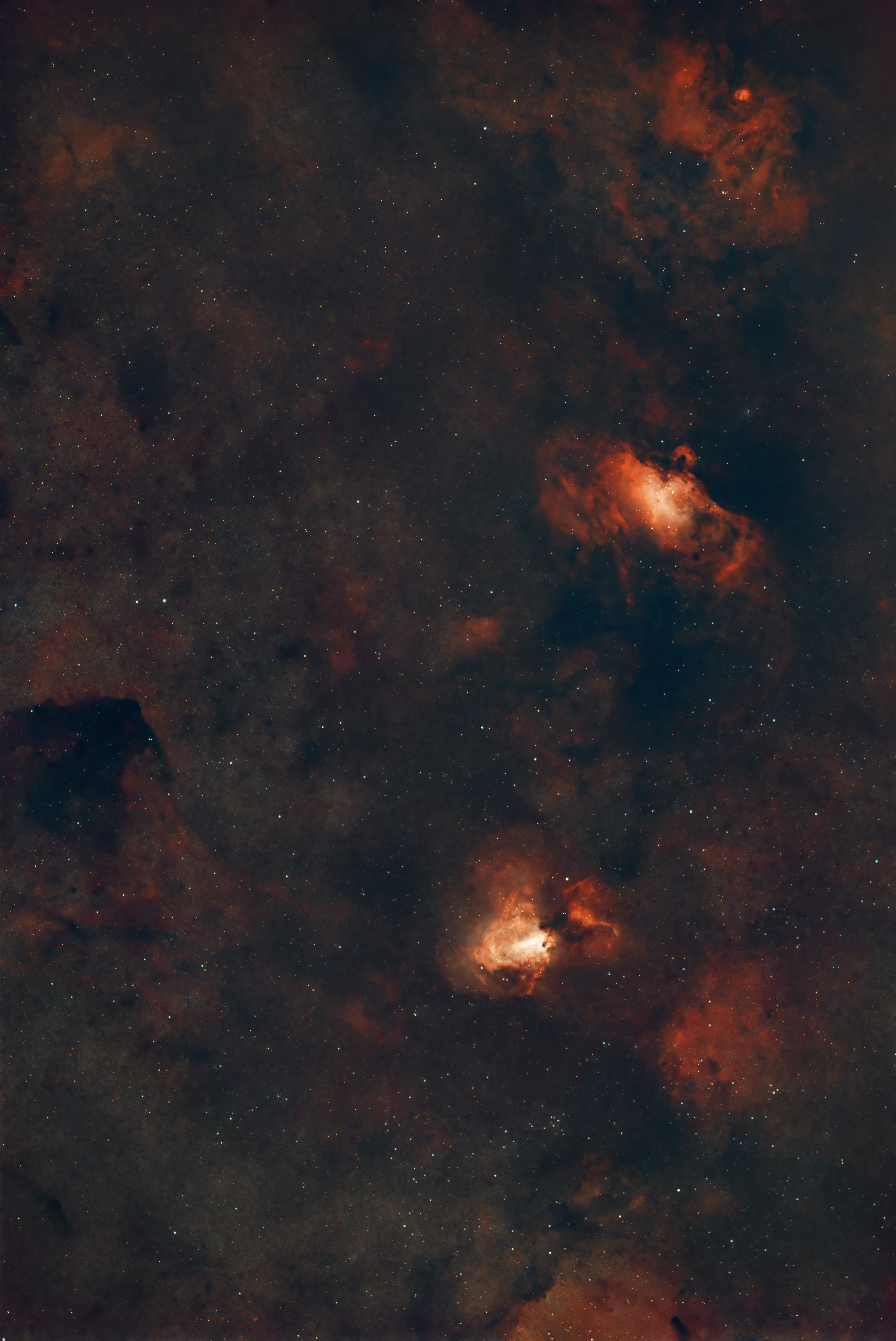
M16-M17 Region (Plate-Solve Test with ASIAIR & SkyGuider)

The most famous objects in this image are M16 (Eagle Nebula) and M17 (Omega Nebula) but several other objects are also in the field. Some of the other noteworthy objects visible are LBN 71 along with NGC 6604 and SH2-54 in the upper right portion. The left side has a lot of other nebular regions, some named, some unnamed. Numerous Sharpless objects, star clusters, and dark nebulae are scattered throughout this image.

The bad news is the stars were not as sharp as the focus was slightly off - my fault being in a hurry. The good news is Bill's Star reduction reduced the star problem quite a bit. The image is not great and I really did not spend a lot of time processing it since I did not have a lot of time on it, the light pollution was horrible in this direction, and the image was not the major focus of this project. The light pollution was so bad I could not make out any stars due to the light glow from Stamford and NYC. I was happy that I was getting something.

So how was I able to even find this given the sky conditions? Using the ASIAIR for Plate-solving. Plate-Solving is standard procedure for using go to mounts, it is less commonly used with tracking mounts such as the iOptron SkyGuider Pro which I was using. It actually worked quite well especially since Jacek Witkowski lent an extra set of hands (Thanks). I could have chosen an easier object that was actually visible to do this test with but I was at the offsite cemetery again and wanted to do something that is not visible very long from my yard.


M16-M17 Region (Plate-Solve Test with the Portable Setup)!
Dates: 8-13
Camera: ZWO ASI2600MC-Pro
Telescope: Canon EF 200mm f/2.8L II USM Lens
Barlow: None
Focal Length: 200mm
f/4 with stepdown rings
Focal Reducer: None
Mount: iOptron SkyGuider Pro
Filter Wheel/Drawer: ZWO EOS Filter Drawer
Filter: IDAS NBZ
Focuser: None
Autoguiding: ASI120 Mini attached to a ZWO Mini 30/120mm Guidescope
Exposure: 51 x 120
Gain: 100
Sensor Temp: 0 C
Processing: NINA, PixInsight, Photoshop, StarXTerminator.
Power: Maxoak K2 Laptop Power Bank

https://www.instagram.com/astroquest1/
http://astroquest1.blogspot.com/
https://www.astrobin.com/users/kurtzepp/collections/
http://youtube.com/c/AstroQuest1

Thursday, August 11, 2022

M27 - Dumbbell Nebula (2022)

Messier 27 (a.k.a. M27) is a planetary nebula located 1200 light-years away in the constellation of Vulpecula and is approximately 5 light-years across. Its odd structure leads to interesting names such as the Apple Core Nebula or more commonly the Dumbbell Nebula. The structure of this object results from the expulsion of gas from a dying star and then having the remaining progenitor white dwarf star ionize the gas so it shines. This particular PN has a strong oxygen (OIII) component as evidenced by the blue-green regions. The red is due to hydrogen (Ha). The formation of the interesting shape is hard to picture because of our orientation, however, what is known is there is a bi-polar influence which is why it does not appear as a sphere like the nearby Ring Nebula.

I imaged this over seven nights at the end of July without any difficulties. Processing turned out quite fun as it is the first image where I processed it completely on my new processing computer. The speed of this new system is quite impressive. For example, it only took 1hr 10min to stack 372 exposures using WBPP where it would have taken approximately 6 hrs using the laptop. I made a video of the new system if you are interested (Link - https://youtu.be/SyyDdTT47WM).

This version was a big improvement over my previous attempts. For one thing I used my AT115 vs. the Orion ED80. It is still a small telescope so I had to crop it quite a bit but I captured more data than before. Another thing I did was use Bill Blanshan's new star reduction methods for PixInsight in processing. The methods worked surprisingly well as the stars were reduced with only a small amount of artifacts on large stars and I was able to fix those without too much effort.
 

M27 - Dumbbell Nebula (2022) 
Dates: 7-19-22, 7-20, 7-21, 7-22, 7-25, 7-26, 7-30
Camera: ZWO ASI1600MM-Pro
Telescope: Astro-Tech AT115EDT 115mm Refractor Telescope
Barlow: None
Focal Length: 805mm (644mm w/ FR)
f/7
Focal Reducer: 0.8x AstroTech Field Flatterner/Focal Reducer
Mount: Orion Sirius
Filter Wheel: ZWO EFW 8 x 1.25"
Filter: ZWO Ha, OIII, R, G, B
Focuser: ZWO EAF
Autoguiding: ASI120 Mini attached to an Agena 50mm Guide Scope/ZWO 60mm Guidescope
Exposure: Ha 85 x 300, OIII 85 x 300, R 74 x 60, G 71 x 60, B 57 x 60
Gain: 139
Offset 20
Sensor Temp: 0 C
Processing: NINA, PixInsight, Photoshop, Topaz DeNoiseAI, StarXTerminator.

https://www.instagram.com/astroquest1/
http://astroquest1.blogspot.com/
https://www.astrobin.com/users/kurtzepp/collections/
http://youtube.com/c/AstroQuest1