Wednesday, March 23, 2022

Horsehead Nebula, Flame Nebula, and Orion Nebula (OHS)

This region of space never disappoints. All the gas and dust that make up the nebulae are part of the Orion Molecular cloud located in the Constellation of Orion. The big three are the Orion Nebula (M42) at ~1344 light-years away, the Horsehead Nebula (B33) at ~1375 light-years away, and finally the Flame Nebula (NGC 2024 & Sh2-277) at ~1350 light-years distance. All three are impressive emission nebulae in their own right but there is a lot of faint secondary gas and dust between the nebulae which is one of the goals for this image.

This is the second time I imaged this with Canon EF 200mm f/2.8L II USM lens only this time I wanted to try something different from last year's traditional HaRGB image so I went with all narrowband. Rather than doing the normal SHO blend I went to an OHS blend that was described by Antoine & Dalia Grelin (Galactic Hunter) when they did this last year. Their image was fantastic and I wanted to see if I could get a decent image of it as well using their method. I am very pleased with the results and I think this blend allowed for more detail to be visible. The swirly gas stringers scattered throughout this field are breathtaking. I especially like the ones above the B33 and the ones south of M42. There is much more fine detail in each nebula than there is in any of my previous attempts. Most times I would not say zoom in but this one holds up even when zoomed in a bit.

In order to do this I connected a ZWO EFW (1.25") to the camera lens using the low profile ZWO adaptor and attached it to my Sirius Mount located in the astronomy shed. In addition, rather than using the internal lens aperture to control the f-stop, I used stepdown rings in order to obtain the focal ratio of f/4. The reason for doing this is that the star shapes come out much better and it eliminates the eight-sided star spikes from the lenses aperture control.

Dates: 2-14-22, 2-15, 2-18, 2-20, 2-21, 2-25, 2-26, 2-27, 2-28, 3-3, 3-4      

https://www.instagram.com/astroquest1/
http://astroquest1.blogspot.com/
https://www.astrobin.com/users/kurtzepp/collections/
http://youtube.com/c/AstroQuest1 


Horsehead Nebula, Flame Nebula, and Orion Nebula
Dates: 2-14-22, 2-15, 2-18, 2-20, 2-21, 2-25, 2-26, 2-27, 2-28, 3-3, 3-4
Camera: ZWO ASI1600MM-Pro
Telescope: Canon EF 200mm f/2.8L II USM Lens
Barlow: None
Focal Length: 200mm 
f/4 with stepdown rings
Focal Reducer: None
Mount: Orion Sirius
Filter Wheel: ZWO EFW 8 x 1.25"
Filter: ZWO Ha, OIII, SII
Focuser: ZWO EAF
Autoguiding: ASI120 Mini attached to a ZWO Mini 30/120mm Guidescope
Exposure: Ha 156 x 180, OIII 94 x 180, SII 141 x 180, Ha 36 x 10, OIII 20 x 10, SII 16 x 10
Gain: 139
Offset 20
Sensor Temp: -20 C
Processing: NINA, PixInsight, Photoshop, Topaz DeNoiseAI, StarXTerminator.

https://www.instagram.com/astroquest1/
http://astroquest1.blogspot.com/
https://www.astrobin.com/users/kurtzepp/collections/
http://youtube.com/c/AstroQuest1

Friday, March 11, 2022

M82 - Cigar Galaxy (2022)

Messier 82 (M82 or NGC 3034) or more commonly known as the Cigar Galaxy is an edge-on galaxy approximately 12 million light-years away in the constellation Ursa Major. M82 is very close to another spectacular galaxy M81 or Bode's Galaxy (a.k.a. NGC 3031) which it is often imaged with. Another nearby galaxy NGC 3077 along with M81 and M82 form what is known as the M81 Local Group. The tidal forces from the largest of the three galaxies, M81, is causing the central portion of M82 to have a star formation rate 10 times that of the Milky Way. This can be seen in the red hydrogen strands emanating from the center of the galaxy.  Getting those streamers was one of my goals and is also one of my favorite parts of the image.

M82 is a very popular object which is usually done every couple of years, however, the last time I did this was five years ago. Why so long, poor FOV and not enough focal length. This is much improved from my previous attempts - Yay, I have improved. I started this in the front lawn since we had a freak warm spell. We had a snowstorm a few days later so I dug a path for my Scopebuggy and collected some good data but the bricks which the buggy rested on froze to the ground so I had to hammer them off and then carefully drag the Scopebuggy over the frozen ground - it was a pretty funny site but not to be repeated. The following nights I found a new location on my driveway that gave three hours of imaging time - good enough.

One particular night I had horrible streaks on two hours of subframes and was thinking my mount was broken. It did not occur to me that the 18 mph plus wind gusts would affect the EdgeHD800 with the dew shield that resembles a giant sail. I got some weather data from a nearby airport and did some analysis - pretty enlightening. I made a video of my findings: 
Link Here: https://youtu.be/72Ec1SzgQ1E.

Processing took my usual way too long but in the end I am happy with what I ended up with.  The very cool red steamers emanating from the central portion show up very well.  I used the IDAS NBZ dual band filter (Ha and OIII) to start with but then decided to get some straight RGB data with the Optolong Luminosity. The RGB data was quite detailed and easily blended the stars into the Ha-OIII image. I tried to do straight blends, split dual blends, split RGB blends but nothing seemed to work. So in the end I did several small incremental galaxy blends to incorporate the RGB galaxy with the one captured with the NBZ filter. Though the Luminosity data showed a lot of detail, it was much noisier than the data collected with the NBZ filter - the background was extraordinarily smooth from the beginning.


M82 - Cigar Galaxy
Dates: 2-20, 2-21, 2-25, 2-26, 2-28, 3-3
Camera: ZWO ASI294MC-Pro
Telescope: Celestron EdgeHD 800
Barlow: None
Focal Length: 2032mm (native)
F/10 (native)
Focal Reducer: Celestron .7 Reducer Lens
Mount: Orion Atlas Pro
Filter Adaptor: ZWO Filter Drawer
Filter: IDAS NBZ (2-inch) and Optolong Luminosity (2-inch)
Focuser: ZWO EAF
Autoguiding: ASI120 Mini attached to an Orion ST80
Exposure: NBZ 153 x 180, Lum 230 x 90
Gain: 139
Offset 0
Temp: -20 C
Processing: Asiair app, PixInsight, Photoshop, Star Exterminator, Topaz DeNoiseAI.

https://www.instagram.com/astroquest1/
http://astroquest1.blogspot.com/
https://www.astrobin.com/users/kurtzepp/collections/
http://youtube.com/c/AstroQuest1

Wednesday, March 2, 2022

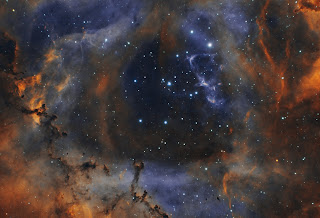
Heart of the Rosette Nebula (SH2-275)

It seems like I am never truly 'done' as I keep doing minor tweaks until I can't stand it anymore, then I am done! So this was my attempt at getting a detailed image of the central portion of the Rosette Nebula also known as SH2-275 or Caldwell 49. Located in Monoceros the Rosette is approximately 5000 Light-years away and 130 LY across. It consists of numerous young stars produced as the gas that makes up the nebula condenses as a result of tidal forces and gravity. Also found here are dark nebulae which completely block light from behind.

The central open star cluster for which my image is focused on is known as NGC 2244. I first imaged this several years ago with a much larger field of view as is commonly done in order to get the entire complex into the image. I really wanted to try and see if I could pull out some fine detail with the Edge800 this time around.

I went with the IDAS NBZ filter which is a dual band (Ha-OIIl) filter for OSC cameras like the ASI294MC which is what I used. This camera pairs up well with the longer focal length Edge800 with the (0.7x) FR. I am very impressed with this Filter as well as it does a great job with this scope at F/7 but also when using the Hyperstar at F/1.9. I have not tried it at the native F/10 but I think I would be pushing my luck at that point. Some of my favorite parts are the bright dense areas on the left along with the dark zones on the bottom. The loop in the central portion came out really well as did the golden swirls on the right side.

In order to get the colors separated the RGB channels and used the red channel for Ha. A blend of 70% green and 30% blue was used to make the OIII. I did try to make a synthetic SII image using various methods but nothing worked out well so I stuck with the HOO combination. The data was pretty good even though I did some imaging when the moon was out (of course not right next to the object). In fact this data was better than I collected on any previous attempt.  Since the moon was out I was very fastidious going through the data and ended up not using 77 exposures (~ one third of the data).

https://www.instagram.com/astroquest1/
http://astroquest1.blogspot.com/
https://www.astrobin.com/users/kurtzepp/collections/
http://youtube.com/c/AstroQuest1

Sharpened


Original

Rosette Nebula SH2-275 (NGC 2244)
Dates: 2-8, 2-9, 2-10, 2-14, 2-15, 2-18
Camera: ZWO ASI294MC-Pro
Telescope: Celestron EdgeHD 800
Barlow: None
Focal Length: 2032mm (native)
F/10 (native)
Focal Reducer: Celestron .7 Reducer Lens
Mount: Orion Atlas Pro
Filter Adaptor: ZWO Filter Drawer
Filter: IDAS NBZ (2-inch)
Focuser: ZWO EAF
Autoguiding: ASI120 Mini attached to an Orion ST80
Exposure: IDAS NBZ 149 x 180
Gain: 139
Offset 0
Temp: -20 C
Processing: Asiair app, PixInsight, Photoshop, Star Exterminator, Topaz DeNoiseAI.

https://www.instagram.com/astroquest1/
http://astroquest1.blogspot.com/
https://www.astrobin.com/users/kurtzepp/collections/
http://youtube.com/c/AstroQuest1

Thursday, February 24, 2022

SH2-278

Sharpless 278 or SH2-278 is a faint emission nebula located in the Orion Molecular Cloud just north of Rigel. There are also some blue reflection nebulae associated with this object, however, they are very faint and would need lots of exposure time in a dark area to bring it out. My sky conditions especially to the south looking in this region are not good so I decided to collect just enough RGB for the stars but forgo the reflection to focus more on the Ha portion. I am happy with this choice as the stars turned out to be quite colorful.

The image is oriented exactly as it would appear if you were looking at it in the Northern Hemisphere where north is on the top, east is left, west is right, and south is on the bottom (Rigel is a bit further south). The nebula has an interesting structure with a large main arc that resembles a flock of birds flying south for the winter. A smaller secondary arc known as LBN 960 is located on the southern arm while a third arc known as LBN 956 is on the northern arm.

The nebula was visible in the stacked red channel but not in either of the green or blue channels. There are also dark structures within emission nebula which form a nice contrast with the red region. I collected data over several nights as it was a good object to do while waiting for other targets to emerge. In addition, I was able to collect Ha data when the moon was partially out as well - lately it only seems to be clear when the moon is out.

Dates: 1-11-22, 1-14, 1-15, 1-18, 1-31, 2-5, 2-8, 2-9, 2-10

https://www.instagram.com/astroquest1/
http://astroquest1.blogspot.com/
https://www.astrobin.com/users/kurtzepp/collections/
http://youtube.com/c/AstroQuest1


SH2-278
Dates: 1-11-22, 1-14, 1-15, 1-18, 1-31, 2-5, 2-8, 2-9, 2-10
Camera: ZWO ASI1600MM-Pro
Telescope: Astro-Tech AT115EDT 115mm Refractor Telescope
Barlow: None
Focal Length: 805mm (644mm w/ FR)
f/7
Focal Reducer: 0.8x AstroTech Field Flatterner/Focal Reducer
Mount: Orion Sirius
Filter Wheel: ZWO EFW 8 x 1.25"
Filter: ZWO Ha, R, G, B
Focuser: ZWO EAF
Autoguiding: ASI120 Mini attached to an Agena 50mm Guide Scope/ZWO 60mm Guidescope
Exposure: None 138 x 180, R 61 x 90, G 54 x 90, B 63 x 90
Gain: 139
Offset 20
Sensor Temp: -20 C
Processing: NINA, PixInsight, Photoshop, Topaz DeNoiseAI, Gradient Exterminator, StarXTerminator.

https://www.instagram.com/astroquest1/
http://astroquest1.blogspot.com/
https://www.astrobin.com/users/kurtzepp/collections/
http://youtube.com/c/AstroQuest1

Sunday, February 20, 2022

Using a Canon EOS Lens with ZWO Filter Wheel. Use Stepdown Rings for Aperture!


Canon EOS lenses can make great astrographs however the backfocus is limited to 44mm.  ZWO has an EOS filter drawer adapter which I showed in a previous video, however, they have another adapter which can be used with their 1.25 inch (31mm) filter wheels and a monochrome camera.  Also, in order to get the optimal star shapes, the aperture should be stepped down.  In a previous video I described a method for adjusting the aperture of Canon Autofocus lenses, however, there is a better way which I describe in this video.

Video is on my Youtube Channel!


Using a Canon 200mm & ASI294MC Pro

https://youtu.be/HczjqhoXANA


Cuiv, The Lazy Geek

https://youtu.be/D78P1h_a50Q


K&F Concept 18 Pieces Filter Ring Adapter Set

https://www.amazon.com/gp/product/B00JL4HGAI?ref=ppx_pt2_dt_b_prod_image


I am now part of the High Point Scientific Affiliate program which means if you purchase anything from High Point Scientific through any of the links listed below, my channel gets a monetary token of appreciation. High Point has price matching and lifetime support on products they sell. 


Kurt’s Highpoint Link: https://www.highpointscientific.com/?...


Kurt’s links

BLOG/WEB : http://astroquest1.blogspot.com/

FACEBOOK : https://www.facebook.com/kurtzepp

TWITTER : https://twitter.com/kurtzepp​

INSTAGRAM : https://www.instagram.com/astroquest1


Thursday, February 17, 2022

The Angel Nebula (NGC 2170, NGC 2182, & others)

The Angel Nebula consists of NGC 2170, NGC 2182, LBN 993, LBN 999, and vdB69 and more. The central object, NGC 2170, is a reflection nebula in the constellation Monoceros approximately 2,400 light-years away. The red-orange cloud in the center is NGC 2170 and is illuminated by the many nearby stars in the region. There are small emission nebulae scattered throughout as well as blue reflection nebulae (NGC 2185 and vdB 68). To top it off, dark nebulae are present in the region and make for a wonderful contrast to the brighter regions.

There are some truly gorgeous images of the region I have seen over the years but this is not one of them. Perhaps if I collected some Ha it would improve but I am not so sure. At a maximum of 42 degrees altitude to the south, I think this is at my low limit for reflection nebulae. It is the same for the Witch Head, which I have tried previously. This was one of the hardest images I have processed because the raw stacked image had so many artifacts. I was almost not going to share it but I did some processing gymnastics to make it look presentable. There are some cool details which I was able to preserve.

If you are interested in the raw raw stacked version I have attached a link.


Raw Image

NGC 2170, NGC 2182, & others
Dates: 1-25, 1-26, 1-31, 2-5
Camera: ZWO ASI294MC-Pro
Telescope: Celestron EdgeHD 800
Barlow: None
Focal Length: 2032mm (native)
F/10 (native)
Focal Reducer: Celestron .7 Reducer Lens
Mount: Orion Atlas Pro
Filter Adaptor: ZWO Filter Drawer
Filter: Baader Optolong Luminosity (2-inch)
Focuser: ZWO EAF
Autoguiding: ASI120 Mini attached to an Orion ST80
Exposure: Optolong Luminosity 213 x 90
Gain: 139
Offset 0
Temp: -20 C
Processing: Asiair app, PixInsight, Photoshop, Star Exterminator, Topaz DeNoiseAI.

https://www.instagram.com/astroquest1/
http://astroquest1.blogspot.com/
https://www.astrobin.com/users/kurtzepp/collections/
http://youtube.com/c/AstroQuest1

Thursday, February 3, 2022

Dreyer's Nebula - IC 447 (& others)

What more can you ask for in the constellation of Monoceros, blue reflection nebulae, dark nebulae, and even red emission nebulae although I did not capture much of that. All of this setting in right in the middle of much more popular objects such as the the Cone Nebula and Rosette Nebula which is why it is not frequently imaged. I was quite pleased with the detail in the blue reflection nebulae especially the smaller ones on the top portion and the gold tones in the background.

Apparently the largest blue reflection nebula was discovered twice, hence the two designations IC 447 and IC 2169. The same can be said of the nearby reflection nebula IC 446/2167 located a half degree north of it. The dark nebula LDN 1607 sits between them. Just southeast of IC 446/2167 puts you at the small reflection nebula vdB 79 and going further east gets you to a larger and more detailed reflection nebula, NGC 2247. Finally, just south of that takes you to one of my favorite parts, the reflection nebula NGC 2245. The swirling gas and dust makes a nice companion to the nearby yellow star. All of the gas and dust in this region is believed to be connected to the Cone Nebula and Christmas Tree Nebula which would make it approximately 2700 light-years away.

For this object I captured approximately four hours of luminosity (no-filter) two hours of each RGB channel for a total of ten hours with my trusty ASI1600. Although I did seem to capture the red Ha-regions which would be on the east side I really like how it turned out - perhaps if I were in a Bortle 3 area and/or used an Ha filter I would have picked it up. The starfield in this region is exceptionally colorful. I did my new trick of only using the RGB stars and blending them into the LRGB starless image using StarXterminator and PixelMath.
 
https://www.instagram.com/astroquest1/
http://astroquest1.blogspot.com/
https://www.astrobin.com/users/kurtzepp/collections/
http://youtube.com/c/AstroQuest1


Dreyer's Nebula - IC 447 (& others)
Dates: 1-7-22, 1-8, 1-22, 1-25, 1-26
Camera: ZWO ASI1600MM-Pro
Telescope: Astro-Tech AT115EDT 115mm Refractor Telescope
Barlow: None
Focal Length: 805mm (644mm w/ FR)
f/7
Focal Reducer: 0.8x AstroTech Field Flatterner/Focal Reducer
Mount: Orion Sirius
Filter Wheel: ZWO EFW 8 x 1.25"
Filter: ZWO L (None), R, G, B
Focuser: ZWO EAF
Autoguiding: ASI120 Mini attached to an Agena 50mm Guide Scope/ZWO 60mm Guidescope
Exposure: None 156 x 90, R 89 x 90, G 81 x 90, B 78 x 90
Gain: 139
Offset 20
Sensor Temp: -20 C
Processing: NINA, PixInsight, Photoshop, Topaz DeNoiseAI, StarXTerminator.

https://www.instagram.com/astroquest1/
http://astroquest1.blogspot.com/
https://www.astrobin.com/users/kurtzepp/collections/
http://youtube.com/c/AstroQuest1