Monday, April 1, 2013


Phlogiston is Finally Put to Rest by Lavoisier

APRIL 2013
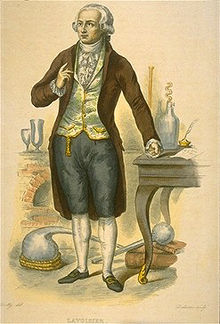
Antoine Lavoisier was a French chemist (1743-1494) who became known as “The Father of Modern Chemistry” with good reason.  He named  oxygen and hydrogen, predicted silicon, helped construct the metric system, and discovered that sulfur was an element rather than a compound to name a few of his achievements.  In one of his more famous experiments, he burnt phosphorus and sulfur in air, and showed that the products although they weighed more than the original, the weight gained was lost from the air, thus establishing the Law of Conservation of Mass.

What about the Phlogiston theory which postulated that materials released a substance called phlogiston when they burned first described in 1667?  The theory was an attempt to explain combustion and rusting and was accepted by most of the scientists of the time.  However, Lavoisier demonstrated the correct role of oxygen in the rusting process as well in respiration. Along with Pierre-Simon Laplace, Lavoisier conducted experiments that showed that respiration was essentially a slow combustion of organic material using inhaled oxygen.  In other words, he disproved the release of phlogiston.

At the age of 28, Lavoisier married 13-year-old Marie-Anne Pierrette Paulze who translated from English to French for him and illustrated his books.  Unfortunately for Lavoisier he was essentially a tax collector for the king during the French Revolution and was tried, convicted, and guillotined on 8 May in Paris, at the age of 50.    

sources:
ScienceWorld: Lavoisier

Monday, March 18, 2013

My Room Was Invaded Last Night!


Molecular Model Winners of 2013

Period A

Ethyl Butanoate (1st)
TNT (2nd)


Period B

Benzoylmethylecgonine (1st)
TNT (2nd)


Period D

Caffeine (1st)
Toluene (2nd)

Period G

Vanillin (1st)
TNT (2nd)


Period H

Octane (1st)
Bucky Ball (2nd)


Other High Honors


Even More:  Flickr

Friday, March 1, 2013


Have You Thought of Torricelli Lately?

MARCH 2013
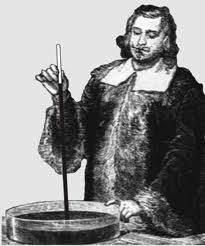
Evangelista Torricelli was born on October 15 in 1608 in Faenza in the Province of Ravenna in Northern Italy.  Torricelli came from a very poor family, however, his parents recognized his talents and sent him to his uncle, Jacobo, a monk, to be properly educated.  He entered a Jesuit College in 1624 to study Math and Philosophy and then was sent to Rome to study science under the Benedictine monk Benedetto Castelli.

Torricelli was big fan of Galileo early in his career and ended up being his transcriber during the last three months of Galileo’s life.  He is probably most famous for inventing the mercury barometer while trying to assist the Grand Duke of Tuscany raise water to a height of 12 meters with a suction pump.  Water can only be raised 10 meters with suction due to the atmospheric pressure.  Torricelli reasoned that mercury, being 14 times more dense than water would rise only 1/14 the height (76 cm).  Another of Torricelli also had the distinction of giving the first scientific explanation for the cause wind.  Unfortunately, he died at a rather young age in 1647 from  typhoid fever.

sources:
wikipedia: Torricelli

Saturday, February 16, 2013

What Does Colored Ice Have To Do With Uranium?

Nothing!  Unless you are in Iran and the ice is glowing.  The following pictures were from my son's latest experiment, Making Neat Looking Colored Ice, which he did during the blizzard.  It kept him busy for a little while as well.  The procedure was quite simple: 1) fill cups with water, 2) add a few drops of food coloring, 3) stir, 4) set outside to freeze, 5) remove from cup.  The results speak for themselves, cool looking ice structures that resemble a lava lamp that has been frozen.  BTW, these are upside down from when they were made.  NEAT!


The ice structures show some interesting features upon closer examination.  Most of the food coloring seems to have been concentrated into a ball shaped structure that has been surrounded by uncolored ice.  You can also see bubble zones in the clear ice which eventually get absorbed by a third zone of ice that mixed with food coloring.  I am not certain when this region crystallized.
I kept the geochemical jargon to a minimum.

So Why the Title?
It turns out the pure water crystallized first concentrating the food coloring into a ball which was the last region to crystallize.

What happened here also mimics what happens when when minerals (crystallize) form from a melt deep inside Earth.  As magma solidifies upon cooling, remaining melt changes composition.  The result is a pluton (solidified magma body) with regions of different composition.

Suppose a magma body containing iron (Fe), magnesium (Mg), potassium (K), uranium (U), and silcica (SiO2) solidifies, the first minerals to form will soak up most the Fe and Mg along with some silica.  Uranium is a large element that prefers to be in a melt.  When the rest of the magma finally solidifies it will have a higher concentration of K, U, and silica.  It so happens that granite represents later stage crystallization, thus is higher in U concentration when compared with most other rocks.  This was a very simplistic explanation. 

Relating this back to the Colored Ice model:  The red food coloring would represent the uranium and potassium.  The clear ice would represent the zone where crystallization of the Fe and Mg takes place.

Why Was All This On My Mind?
Someone in my son's cub scout troop was concerned about his granite counter top having radon (Rn) gas.  Since granite has a higher U concentration and Rn is daughter product of U when it decays, most anything granite does emit Rn gas.

Oh No!  Should you rip out the counter tops or sell the house?
No!  Although concentrations of Rn may be higher than background levels they are not high enough for any concern as you don't have enough granite.  Some houses, however, that have granite for bedrock should get there basements checked for radon as that is a potential hazard especially since there is minimum ventilation.

FYI - I have granite counter tops in my bathrooms.

Sunday, February 10, 2013

How Many Gallons of Water Did You Shovel?

My answer to Mike Sirowich's (Physics Teacher Extraordinaire at SHS) Physics Tweet from 2/9/13 (SHScatphysics) regarding how many gallons of water did you shovel came out to be 6355 gallons.  The solution takes in many assumptions of course.  On average a little over 2 feet of snow fell in our driveway.  Also, I have an irregular shaped driveway that is 190 ft long and varying widths.

The approximate dimensions that I removed was as follows:
130 x 7.5 = 975 ft2  
28 x 60. = 1680 ft2
       The total area = 2655 ft2  

Now to add the third dimension and the most varied assumption, the snow to water conversion.  Online I found two common conversions: 1 inch water to 10 inches of snow and the more common  1 inch water to 6.25 inches of snow.  It really depends on the type of snow that falls.  My son's experiments came up with 1 inch of water to 5 inches of snow which is more inline with the 1 to 6.25 conversion so I will use that as the conversion factor.

1) Convert snow to water: 24 in of snow/6.25 = 3.84 in of water
2) Convert inches of water to feet: 3.84 in of water/12 = 0.32 ft of water

            3) Calculate volume:  2655 x 0.32 = 849.6 ft3

Finally convert the volume from cubic feet to gallons (1 cubic foot = 7.48 gal):

849.6 ft3 x 7.48 gal = 6355 gallons of water

In science (as well as the rest of the world) we use the Metric System so (1 gal = 3.78 L):  
24,022 L


Friday, February 1, 2013


FEBRUARY 2012
Only fitting that that I select a scientist who was instrumental on my next topic.  Gilbert Newton Lewis was born in Weymouth, MA on October 23, 1875.  Lewis entered the University of Nebraska at age 13 and transferred to Harvard in 1894 where he received a BS degree in Chemistry and then a Ph.D. at age 24.  He went to work for Wilhelm Ostwald and Walther Nernst in Germany and then spent time in the Philippines with the Bureau of Weights.  Later returned to Massachusetts where he was appointed to a professorship at  Massachusetts Institute of Technology (MIT).  In 1912 he obtained a professorship with the University of California at Berkeley where he remained for the rest of his life.

In 1916 he published a paper “The Atom and the Molecule” where he describes his theory of bonding where there are eight electrons in the outer orbit of an atom and the electrons are represented with dots (Lewis Dot Structures).  In addition, he developed new classifications for acids and bases and performed photochemical experiments.  Another distinction for Lewis was that coined the term “photon” although he intended for it to be structural unit rather than one quantum of light energy.  Very few people have been nominated for Nobel Prizes but Lewis is the only one who could say they have been nominated 35 times never to win.  A chemist to the end, Lewis died in his laboratory in 1946.

sources:
Gilbert Newton Lewis
wikipedia: Gilbert N. Lewis

Sunday, January 27, 2013


The End of the Dreaded Lab Report

I am pretty sure that starting next year I will no longer require the students write a formal lab report (i.e., title page, purpose, procedure, data, conclusions) which is due the following week.  Instead students will have to complete a set of directed questions pertaining to the purpose in class and a set of questions outside of class.  The questions outside of class will be done online for the most part.  Half of the credit will be for completion and the other half is for their understanding of the results.  This will be for all chemistry classes which includes College Prep, Honors, and AP Chem.  Seymour High School is getting rid of the Core class designation next year and those students will be incorporated into College Prep classes.

Why get rid of the formal lab reports?  There numerous reasons but one that sticks out is my beloved technology.  Years ago students had to research lab questions, construct tables and graphs based on the experiment, and put them into a handwritten report.  Now, they look up the info online and just cut and paste it into the report without reading it or comprehending it.  I prefer they construct tables and graphs with the computer, however, I am not sure who did the graph these days.  In addition, they will send this to their friends who change a couple things or not and submit this as their own work (notice I didn’t use the word plagiarize - that’s another blog post).  I could require students to hand everything in by hand but I think this new approach will be friendlier for less motivated students.  Also, this takes care of another issue, absenteeism.  If a student misses the experiment, I can give them some data so they can complete the questions.  Of course it would be easier if they were there for the experiment.

Lab reports are important but the implementation or grading is not antiquated well with the times.  I haven’t the time to set up the lab, take down the lab, grade the report, and then ensure that each student completes their own report.  Universities and Colleges typically have Lab as a separate course where a Teaching Assistant does the work.  

I have discussed this with Tony Ciccone, Seymour Chem Teacher emirates, as well as a colleague in another district who no longer requires formal lab reports.  He has very good results especially with his AP Chem class.   I think this new approach will be less time consuming for me once it is implemented and more importantly, better for the students.

Comments are welcome, especially from other HS chem teachers...