Thursday, December 27, 2012

Frying Calamari in Batter


Our Christmas Eve dinner consists of a variety fish and pasta of which I claim no credit or preparing.  I was watching my sister-in-law, Pattaya, fry calamari and was of course interested in understanding what the heck was going on as she was dipping each piece in flour and then into a yummy batter.  She explained (and then demonstrated as shown in the 1st couple of seconds of the video) that the batter simply drips off the calamari and therefore dips it into the flour first as it makes the batter sticks better.

This makes sense as calamari is quite slippery due to its oily nature.  Flour, being a fine powder made from grain contains starches which stick to most liquids and allows the batter to stick to the calamari.  The end result was delicious!  Also thanks to my sister and my wife for making this dinner possible.

sources:
chemistrydaily

Thursday, December 20, 2012

HAPPY WINTER SOLSTICE!

In the Northern Hemisphere the winter solstice occurs when the Sun is at its greatest distance from the earth's equator and falls on either December 21 or 22 when the sun shines directly over the tropic of Capricorn.  The summer solstice occurs on June either June 20 or 21 when the sun shines directly the tropic of Cancer.  In the Southern Hemisphere the solstices are reversed.

The winter solstice also represents the shortest day of the year while the summer solstice represent the longest day of the year.  Many cultures and religions have festivals, celebrations, and gatherings around this time of year.  Keeping track of the time of year is not a new invention as it was extremely important for crop production and such.  Many archaeological sites are identified with keeping track of the summer and winter solstice.  One of the most famous being Stonehenge in England.


sources:
wikipedia
infoplease

Friday, December 7, 2012

Interesting View of the Sun


Though it is never advisable to look directly at the sun, the other day while leaving SHS my colleague, Mike Sirowich, noticed the unusual view of the sun being partially blocked by fog and some low-lying clouds.

Saturday, December 1, 2012


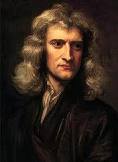
It's Newton!

DECEMBER 2012
You knew Isaac Newton had to show up sooner or later so I figured December would be good since he was born on Christmas Day in 1642 (or was he?) according to the calendar used in England at the time.  England had not adopted the Gregorian calendar yet which would list his birthday as January 4, 1643.  Newton was born in Woolsthorpe Manor in Lincolnshire county in England and is arguably the most influential scientist the who ever lived.  In his 1687 book the PhilosophiƦ Naturalis Principia Mathematica, Newton described universal gravitation and the three laws of motion know known as Newton's Three Laws.  In the field of optics he built the first built the first working reflecting telescope and discovered white light to be combination of the many colors of visible spectrum.  In the field of mathematics, he along with  Gottfried Leibniz, is credited for the discovery of differential and integral calculus.

In the later years, Newton became a member of Parliament and also secured a post at the  Royal Mint.  In 1699 he became Master of the Mint and held on to this position until his death.  He took this position very seriously as counterfeiting was considered high treason punishable by hanging and then being drawn and quartered.  Newton was made president of the  Royal Society in 1703 and knighted in 1705.  He died in London in 1727 and was buried in Westminster Abbey.

sources:
wikipedia: Isaac Newton

Friday, November 23, 2012

Botany and Physics meet at the NYBG


Every year since 1992 the New York Botanical Garden puts on the Holiday Train Show that features model trains and trolleys winding their way though New York area landmarks.  The models, handmade by Paul Busse and his group from Applied Imagination, are constructed from sticks, bark, stems, and seeds among other natural materials.  We have visited this evolving seasonal exhibit for years and are always pleasantly surprised, minus the crowds of course (they get smaller ounce you get past the beginning).


The bridges zigzag throughout the entire exhibit and are very sturdy and well built.  An engineering marvel put together with twigs and such.  Other models show intricate craftsmanship and authenticity as the models represent what original building looked like when first constructed.

For more pics: Train Pics

Tuesday, November 20, 2012

A Visit To Tory's Cave

Our newly formed, or perhaps want-to-be-formed, Seymour High School Faculty Adventure club consisting of Jim Freund (Assistant Principal), Stephanie Shelinsky (English), Paula Burton (Math) and yours truly (Science) explored Tory's Cave in New Milford CT.  Jim, no relation to Marlin Perkins sidekick on Mutual of Omaha's Wild Kingdom but is a former Outdoor Guide, led the expedition.  He explained how the cave got its name during the Revolutionary days when British sympathizers (Torys) used to hide out in the cave.  The cave is one of very few solution formed caves in Connecticut and the only one open to the public.  The passage was narrow and drops into to a larger room capable of holding perhaps a dozen people.

Other Pics
The cave is 55 °F year round and is home to bats during the winter months.  There were none when we visited on November 14th.  There are no stalactites or stalagmites but there is very neat looking flowing marble with a golden hue.  We all really enjoyed exploring the cave and just being in it.  The climax was when we turned off our lights and just listened in the pitch black at the slow dripping of water ever changing the cave.

Saturday, November 10, 2012

Ouch - Hot Pizza!

When eating pizza the recently with my family, my wife and I burned the roof of our mouth's as so many people do.  The next time we had pizza we waited several minutes before chowing down.  While waiting my son was asking why the crust did not feel hot while the cheese was very steamy even after several minutes.  A great question!


I immediately proceeded in giving some long-winded explanation to an 8-year old about the heat capacity of cheese being higher than the heat capacity of the crust.  Of course I had to explain that heat capacity (C) is amount of heat energy (q) needed to raise the temperature (Ī” T) of a specific amount of substance (mass, m).

The formula:  q = C × m × (Ī” T)

The higher the Heat Capacity the longer it stays hot.  In addition, bread is a good insulator so it transfers heat very slowly while mozzarella cheese being a better conductor transfers heat faster.

After after giving this explanation I asked my son if he understood, to which he replied, "Oh I got it, the crust has lots of holes in it like bread or bubbles which means it won't get as hot".  His explanation is essentially correct (replace get as hot with hold as much heat) and is simpler to understand than mine.  The crust is much less dense than the cheese, thus the same volume of cheese can hold a lot more heat than the same volume of crust.  In think I will run explanations through him from know on.

Believe it or not, others have studied this topic.  For more information checkout: The Thermodynamics of Pizza from ChemPRIME.