Thursday, February 3, 2022

Dreyer's Nebula - IC 447 (& others)

What more can you ask for in the constellation of Monoceros, blue reflection nebulae, dark nebulae, and even red emission nebulae although I did not capture much of that. All of this setting in right in the middle of much more popular objects such as the the Cone Nebula and Rosette Nebula which is why it is not frequently imaged. I was quite pleased with the detail in the blue reflection nebulae especially the smaller ones on the top portion and the gold tones in the background.

Apparently the largest blue reflection nebula was discovered twice, hence the two designations IC 447 and IC 2169. The same can be said of the nearby reflection nebula IC 446/2167 located a half degree north of it. The dark nebula LDN 1607 sits between them. Just southeast of IC 446/2167 puts you at the small reflection nebula vdB 79 and going further east gets you to a larger and more detailed reflection nebula, NGC 2247. Finally, just south of that takes you to one of my favorite parts, the reflection nebula NGC 2245. The swirling gas and dust makes a nice companion to the nearby yellow star. All of the gas and dust in this region is believed to be connected to the Cone Nebula and Christmas Tree Nebula which would make it approximately 2700 light-years away.

For this object I captured approximately four hours of luminosity (no-filter) two hours of each RGB channel for a total of ten hours with my trusty ASI1600. Although I did seem to capture the red Ha-regions which would be on the east side I really like how it turned out - perhaps if I were in a Bortle 3 area and/or used an Ha filter I would have picked it up. The starfield in this region is exceptionally colorful. I did my new trick of only using the RGB stars and blending them into the LRGB starless image using StarXterminator and PixelMath.
 
https://www.instagram.com/astroquest1/
http://astroquest1.blogspot.com/
https://www.astrobin.com/users/kurtzepp/collections/
http://youtube.com/c/AstroQuest1


Dreyer's Nebula - IC 447 (& others)
Dates: 1-7-22, 1-8, 1-22, 1-25, 1-26
Camera: ZWO ASI1600MM-Pro
Telescope: Astro-Tech AT115EDT 115mm Refractor Telescope
Barlow: None
Focal Length: 805mm (644mm w/ FR)
f/7
Focal Reducer: 0.8x AstroTech Field Flatterner/Focal Reducer
Mount: Orion Sirius
Filter Wheel: ZWO EFW 8 x 1.25"
Filter: ZWO L (None), R, G, B
Focuser: ZWO EAF
Autoguiding: ASI120 Mini attached to an Agena 50mm Guide Scope/ZWO 60mm Guidescope
Exposure: None 156 x 90, R 89 x 90, G 81 x 90, B 78 x 90
Gain: 139
Offset 20
Sensor Temp: -20 C
Processing: NINA, PixInsight, Photoshop, Topaz DeNoiseAI, StarXTerminator.

https://www.instagram.com/astroquest1/
http://astroquest1.blogspot.com/
https://www.astrobin.com/users/kurtzepp/collections/
http://youtube.com/c/AstroQuest1

Sunday, January 23, 2022

NGC 1499 - California Nebula (NB with RGB Stars)

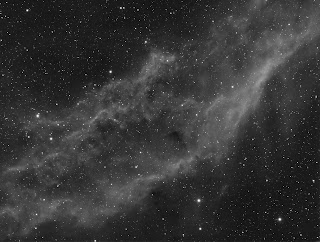
NGC 1499 is an emission nebula approximately 100 light-years long and located only about 1,000 light-years away in the constellation of Perseus. Emission nebulae get their energetic glow from electrons recombining with atoms after they were stripped away by ionizing radiation from nearby stars (hydrogen is most common). The responsible star for this nebula is believed to be Xi Persei, a hot blue star which is unfortunately just off the top central part of my image.

When oriented 90 degrees from this orientation it resembles the State of California which it is commonly known as. It is a very popular object but only the second time for me - the first was four years ago. That was one of the first images I did with the Astronomik Ha Clip-In Filter. Ironically, I reprocessed that image eight months later when I tried PixInsight for the first time.  That PI version is a great improvement. It is hard to compare with this version since I used a modified Hubble Palette but I think it is better. I really like the sharp wispy dendrites scattered throughout the gold region of the Nebula.

I chose to do it using narrowband filters as I needed an object that could be done when the moon is out since that is the only time it has been clear in the last two months. The SII (sulfur) came out really well. The Ha (hydrogen) was ok but there were some gradients most likely caused by wispy clouds and poor transparency. The OIII (oxygen) was not that good at all - it was barely visible and noisy. Attached is a link to my website that has the stacked data.
 
(link, https://astroquest1.blogspot.com/2022/01/ngc-1499-california-nebula-nb-with-rgb.html). 

It may be that oxygen just is not that abundant in this nebula. The RGB data was pretty good, especially red, but I only used it for the stars.

As a result of the poor oxygen I did some PixelMath gymnastics to make a presentable combination. After numerous combinations with and without the oxygen I used: S - red; Ha - green; and S 40%, Ha 40%, OIII 20%. I use PixelMath for many other things as well such as bringing stars back and sharpening. Although I did not get the richness I hoped for, the stars came out well and the translucent detail was there. Also on the website link is the b&w luminosity layer. I attached it as some objects seem to show more detail in black and white in my opinion. This is one and the Horsehead in another.

https://www.instagram.com/astroquest1/
http://astroquest1.blogspot.com/
https://www.astrobin.com/users/kurtzepp/collections/
http://youtube.com/c/AstroQuest1   


NGC 1499 - California Nebula
Dates: 12-12-21, 12-13, 12-19, 12-20, 12-20, 1-3-22, 1-4, 1-7, 1-8
Camera: ZWO ASI1600MM-Pro
Telescope: Astro-Tech AT115EDT 115mm Refractor Telescope
Barlow: None
Focal Length: 805mm (644mm w/ FR)
f/7
Focal Reducer: 0.8x AstroTech Field Flatterner/Focal Reducer
Mount: Orion Sirius
Filter Wheel: ZWO EFW 8 x 1.25"
Filter: ZWO Ha, OIII, SII, R, G, B
Focuser: ZWO EAF
Autoguiding: ASI120 Mini attached to an Agena 50mm Guide Scope/ZWO 60mm Guidescope
Exposure: Ha 112 x 180, OIII 98 x 180, SII 93 x 180, R 60 x 60, G 59 x 60, B 46 x 60
Gain: 139
Offset 20
Sensor Temp: -10 C/-20 C
Processing: NINA, PixInsight, Photoshop, Topaz DeNoiseAI, Gradient Exterminator, StarXTerminator.

https://www.instagram.com/astroquest1/
http://astroquest1.blogspot.com/
https://www.astrobin.com/users/kurtzepp/collections/
http://youtube.com/c/AstroQuest1

Luminosity

Hydrogen 

Oxygen

Sulfur

Sunday, January 16, 2022

VdB 47 - Sh2-243

Canadian Astronomer Sidney van den Bergh published a catalog of reflection nebulae in 1966 and this was his 47th entry. VdB 47, also known as Sh2-243, is a reflection nebula illuminated by an orange supergiant star, HD 37387, which is also responsible for the nebula's unique yellow-orange color. In my image it is the largest bright yellow star in the center of the image. The bright blue star southwest of the illuminating star is actually two stars but it is unclear if they are orbiting each other. Located 6500 light-years in the constellation of Taurus this nebula may be associated with a larger cloud in the region. It is also listed as a Sharpless Catalog object (Sh2-243) which suggests ionizing hydrogen, however, very little ionizing hydrogen has been detected.

I really like reflection nebulae and this one does not disappoint especially with its unusual color.  Most reflection nebulae that I have seen are blue, white, or brown.  There are very few pictures of this on Astrobin most likely because it is overshadowed by much more popular objects such as M1 (Crab Nebula) which is only 1.5 degrees away and all of the Orion stuff which it borders.  Another difficulty of this object is that it is a reflection nebula so the sky has to be pretty dark (i.e. no moon).  The star field looked pretty interesting to me as well so although I did some star reduction, I tried to keep it minimal - plus I like stars anyway.
 
Dates: 1-3, 1-4, 1-7, 1-8

https://www.instagram.com/astroquest1/
http://astroquest1.blogspot.com/
https://www.astrobin.com/users/kurtzepp/collections/
http://youtube.com/c/AstroQuest1


VdB 47 - Sh2-243
Dates: 1-3, 1-4, 1-7, 1-8
Camera: ZWO ASI294MC-Pro
Telescope: Celestron EdgeHD 800
Barlow: None
Focal Length: 2032mm (native)
F/10 (native)
Focal Reducer: Celestron .7 Reducer Lens
Mount: Orion Atlas Pro
Filter Adaptor: ZWO Filter Drawer
Filter: Baader Optolong Luminosity (2-inch)
Focuser: ZWO EAF
Autoguiding: ASI120 Mini attached to an Orion ST80
Exposure: NBZ 252 x 90
Gain: 139
Offset 0
Temp: -20 C
Processing: Asiair app, PixInsight, Photoshop, Gradient Exterminator, Star Exterminator, Topaz DeNoiseAI.

https://www.instagram.com/astroquest1/
http://astroquest1.blogspot.com/
https://www.astrobin.com/users/kurtzepp/collections/
http://youtube.com/c/AstroQuest1

Wednesday, December 29, 2021

NGC 1514 - Crystal Ball Nebula

NGC 1514 (a.k.a. The Crystal Ball Nebula) is a planetary nebula located 650-2,200 light-years away in the constellation Taurus. Planetary nebulae are formed when a star expels the outer layers of material during its final stages. The estimated expansion rate of NGC 1514 is 25 km/s. Although it does not look much of a 'Crystal Ball' to me, it does show some really cool structure. It is described as a double-shell nebula where the inner consists of blobs and filaments approximately 65" and a faint halo approximately 90". This nebula has an interesting blue-green color and the progenitor star visible in the center is actually a binary system. I cropped it quite a bit but wanted to keep the bright yellow star (HIP 19397) to the South and the bright white star in the North.

I did a little star reduction but not too much as I like star fields. So this is my first image in a long while without the Hyperstar and I am pleased with the results. I plan to do more imaging of smaller FOV objects which is why I ordered the EdgeHD800 instead of the RASA in the first place. I did have a return of the ASI294MC and PI red splotches when using a NB filter issue but I was able to 'fix' it. I really like this camera but there is something with the sensor and Ha in particular. ZWO says the sensor passes all the tests and that the red splotches can be removed with calibration which they can. If you do get a color version of this camera, be aware of using it with Ha filters.

https://www.instagram.com/astroquest1/
http://astroquest1.blogspot.com/
https://www.astrobin.com/users/kurtzepp/collections/
http://youtube.com/c/AstroQuest1


NGC 1514 - Crystal Ball Nebula
Dates: 12-12, 12-13, 12-20, 12-22
Camera: ZWO ASI294MC-Pro
Telescope: Celestron EdgeHD 800
Barlow: None
Focal Length: 2032mm (native)
F/10 (native)
Focal Reducer: Celestron .7 Reducer Lens
Mount: Orion Atlas Pro
Filter Adaptor: ZWO Filter Drawer
Filter: Baader IDAS NBZ (2-inch)
Focuser: ZWO EAF
Autoguiding: ASI120 Mini attached to an Orion ST80
Exposure: NBZ 75 x 180
Gain: 139
Offset 0
Temp: -10 C
Processing: Asiair app, PixInsight, Photoshop, Gradient Exterminator, Star Exterminator, Topaz DeNoiseAI.

https://www.instagram.com/astroquest1/
http://astroquest1.blogspot.com/
https://www.astrobin.com/users/kurtzepp/collections/
http://youtube.com/c/AstroQuest1
Wednesday, December 22, 2021

M45 - The Pleiades

The Pleiades is such a wonderful cluster which has been recognized since ancient times and is also my favorite open cluster. It is easily visible with the naked eye unlike so many other objects and it is relatively easy to locate due to its close proximity to the bright star Aldebaran which is halfway between The Pleiades and Orion. Located in the Constellation of Taurus at 444 light-year from our solar system,

M45 is made up of 500 to 1000 mostly hot blue stars. It turns out the nine brightest stars of the are named for the Seven Sisters of Greek mythology: Sterope, Merope, Electra, Maia, Taygeta, Celaeno, and Alcyone. The other two stars are their parents Atlas and Pleione.

This region of space contains a huge amount of dust and the open cluster is currently passing through it creating a gorgeous blue reflection nebula. So I feel like I cheated on this object as the total exposure was just under an hour. I was not planning to image this since I was about to remove the Hyperstar for a while, however, there were a couple of exceptionally clear nights with no moon and the weather was not looking good for the rest of the week so I decided to image something bright that I could finish in one or two nights. I was planning on more exposures but clouds moved in so all I managed was about an hour - but what an hour. This image is just as good as my previous versions with much longer time, hence the Hyperstar allows you to cheat. One of my favorite parts of the image is the dusty spires which came out much better than I anticipated. Ironically, the stars are better on this Hyperstar image than on my previous Hyperstar images in my opinion. Maybe it is because the exposures were only 30 seconds this time.

https://www.instagram.com/astroquest1/
http://astroquest1.blogspot.com/
https://www.astrobin.com/users/kurtzepp/collections/
http://youtube.com/c/AstroQuest1


M45 - The Pleiades
Dates: 12-3, 12-4 
Camera: ZWO ASI294MC-Pro
Telescope: Celestron EdgeHD 800
Barlow: None
Focal Length: 2032mm (native)
F/10 (native) F/1.9 (Hyperstar)
Focal Reducer: Starizona Hyperstar
Mount: Orion Sirius
Filter Adaptor: Starizona Filter Drawer
Filter: Optolong L
Focuser: ZWO EAF
Autoguiding: ASI120 Mini attached to an Agena 50mm Helical Guidescope
Exposure: L 105 x 30s
Gain: 139
Offset 20
Temp: 0 C
Processing: Asiair app, PixInsight, Photoshop, Topaz DeNoiseAI.

https://www.instagram.com/astroquest1/
http://astroquest1.blogspot.com/
https://www.astrobin.com/users/kurtzepp/collections/
http://youtube.com/c/AstroQuest1

Sunday, December 19, 2021

Autoguiding Quad Table

Jpeg Version


Copy Version:

Autoguiding Quadrant Table

Good Autoguiding numbers: 

    ~1.0 - 0.5“ or less


Stars:

  • Tight

  • Round 


All systems are good! 


Recommendation:

  • Keep doing what you are doing!


Good Autoguiding numbers: 

    ~1.0 - 0.5” or less


Stars:

  • Bloated

  • Oblong


The Autoguiding system is working but it does not match well with the imaging train!  


Recommendation:

  • Use a larger Guidescope or an Off-Axis Guider!

Fair to poor Autoguiding numbers: 

    ~1.0 - 0.5” or more


Stars:

  • Tight

  • Round 


The Autoguiding system is good but some settings may be off!


Recommendation:

  • Check settings when convenient.

Fair to poor Autoguiding numbers: 

    ~1.0 - 0.5” or more


Stars:

  • Bloated

  • Oblong


The Autoguiding system is not working.  It may work or it does not match well with the imaging train and or the settings may be off!  


Recommendation:

  • Check settings ASAP.

  • Use a larger Guidescope or an Off-Axis Guider!

Saturday, December 11, 2021

LBN 569

LBN 569 (Lynds' Catalog of Bright Nebulae) is a rarely imaged molecular cloud in Cepheus. As of this writing there are only 5 other images on Astrobin all of which are better than this and taken in Bortle 4 or less skies. This is the best I can do with Bortle 5 skies directly overhead but degrading quickly below 50 degrees altitude. I am very happy I got something as the subframes were completely blown out with light pollution and I had no way of knowing if I was capturing anything. The gradients were extreme when I first saw the stacked image even after flats and background extraction. I had to crop it quite a bit just to get rid of the heaviest gradients.

I really like these molecular clouds but you really need better skies for doing them justice. I first found out about this one from Goran Nilsson who seems to be on a mission with these types of 'clouds' from his location in Sweden. Not much is written about this object, only that LBN 569 is next to MBM 163 - 165 (Magnani, Blitz & Mundy). I really like the central structure of the cloud as well as the detail in the lower right corner which I had 'uncovered' from the LP gradient. I also used the StarXterminator program though it did a great job of removing the stars plus it was much quicker than Starnet.

Based on my limited results so far with my sky conditions, for imaging molecular clouds with Hyperstar - use with the ASI1600MM rather than the ASI294MC. However, I have successfully used the EdgeHD800 without the Hyperstar and the ASI294MC.

https://www.instagram.com/astroquest1/
http://astroquest1.blogspot.com/
https://www.astrobin.com/users/kurtzepp/collections/
http://youtube.com/c/AstroQuest1


LBN 569
Dates: 11-13, 11-29, 12-3
Camera: ZWO ASI1600MM-Pro
Telescope: Celestron EdgeHD 800
Barlow: None
Focal Length: 2032mm (native)
F/10 (native) F/1.9 (Hyperstar)
Focal Reducer: Starizona Hyperstar
Mount: Orion Sirius
Filter Adaptor: Starizona Filter Drawer
Filter: Optolong L
Focuser: ZWO EAF
Autoguiding: ASI120 Mini attached to an Agena 50mm Helical Guidescope
Exposure: L 418 x 90s
Gain: 139
Offset 20
Temp: 0 C
Processing: Asiair app, PixInsight, Photoshop, Topaz DeNoiseAI.

https://www.instagram.com/astroquest1/
http://astroquest1.blogspot.com/
https://www.astrobin.com/users/kurtzepp/collections/
http://youtube.com/c/AstroQuest1