Thursday, November 1, 2018

Sunday, October 21, 2018
M31 - Andromeda (2018)
This is my first image of Andromeda, our sister galaxy, in over three years. Andromeda is a spiral galaxy located 2.5 million light-years from the Milky Way and is heading towards us. It will collide with us in about 4.5 billion years resulting in the formation of an elliptical galaxy. Recent observations from the Spitzer telescope reveal Andromeda contains one trillion stars which is more than double in the Milky Way.
There are a couple of big differences from my image of three years ago, 1) in this new image I framed it 25 degrees off the declination line so I could get entire galaxy, 2) in addition to collecting LRGB data, I also collected Ha data as I wanted show regions of nebulosity. I did manage to combine the Ha data into the LRGB image in PI but it was not as easy as combining nebula images. It was a trial and error approach as PI has many different options for combining images and I had to try many different methods before I found one that worked okay.
More learning:
I have been using APT for well over six months now as my main camera controller and have been liking everything about it except the focusing. I used BYEOS to focus when I still had the DSLR as the FWHM did not jump around nearly as much as it does with APT. When I got the ZWO ASI1600 BYEOS was not an option. I purchased a a Bahtinov mask which worked well with SGP as it gave a nice big view to adjust but APT gave me this barely visible view. I also could not see nebulae or other things to check the framing. I knew I must be missing something as I can't believe so many AP use this program. Finally, I pressed the log scale button to give the maximum exposure and eureka - I the star spikes are clearly visible and so are nebulae. Yes, I feel like an idiot which makes me the perfect person to write or make the Idiots Guide to APT youtube videos.
HaRGB

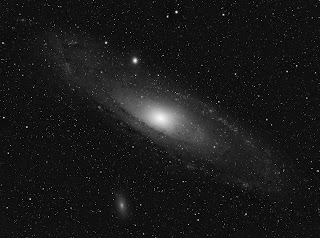

There are a couple of big differences from my image of three years ago, 1) in this new image I framed it 25 degrees off the declination line so I could get entire galaxy, 2) in addition to collecting LRGB data, I also collected Ha data as I wanted show regions of nebulosity. I did manage to combine the Ha data into the LRGB image in PI but it was not as easy as combining nebula images. It was a trial and error approach as PI has many different options for combining images and I had to try many different methods before I found one that worked okay.
The final image is an improvement over my original, however, I wish it were a little more detailed. I do like the star field and the two satellite galaxies M110 and M32 both are resolved. I think had I gotten more RGB data and luminosity on a clearer night would have improved the quality. Waiting perfect nights to image in NE is few and far between. I did successfully add the Ha data and all of the small red areas located on the spiral arms around the edges are regions of high Ha activity or nebulae. These are areas where star formation is taking place. If we were in Andromeda looking at the Milky Way I imagine we would see something similar.
More learning:
I have been using APT for well over six months now as my main camera controller and have been liking everything about it except the focusing. I used BYEOS to focus when I still had the DSLR as the FWHM did not jump around nearly as much as it does with APT. When I got the ZWO ASI1600 BYEOS was not an option. I purchased a a Bahtinov mask which worked well with SGP as it gave a nice big view to adjust but APT gave me this barely visible view. I also could not see nebulae or other things to check the framing. I knew I must be missing something as I can't believe so many AP use this program. Finally, I pressed the log scale button to give the maximum exposure and eureka - I the star spikes are clearly visible and so are nebulae. Yes, I feel like an idiot which makes me the perfect person to write or make the Idiots Guide to APT youtube videos.
HaRGB

Ha

Luninosity

M31 - Andromeda Galaxy HaRGB
Location: Home Monroe, CT
Date: 9-28-18, 9-29-18, 10-3-18, 10-4-18, 10-13-18, 10-14-18
Camera: ZWO ASI1600MM-Pro
Telescope: Orion ED80 80mm f/7.5 Apochromatic Refractor Telescope
Barlow: None
Focal Length: 600mm
f/7.5
Focal Reducer: Orion 0.8x Focal Reducer for Refractor Telescopes
Mount: Orion Sirius EQ
Filter Wheel: ZWO EFW 8x 1.25"
Filter: ZWO Ha, L, R, G, B
Autoguiding: QHY-5L-II-M attached to an Agena 50mm Guide Scope with Helical Focuser
Exposure: Ha 40 x 180s, L 60 x 60s, R 39 x 60, G 34 x 60, 36 x 60
Gain: 139
Offset 21
Temp: -10 C
Post Processing: PixInsight and Photoshop
https://kurtzeppetello.smugmug.com/
Date: 9-28-18, 9-29-18, 10-3-18, 10-4-18, 10-13-18, 10-14-18
Camera: ZWO ASI1600MM-Pro
Telescope: Orion ED80 80mm f/7.5 Apochromatic Refractor Telescope
Barlow: None
Focal Length: 600mm
f/7.5
Focal Reducer: Orion 0.8x Focal Reducer for Refractor Telescopes
Mount: Orion Sirius EQ
Filter Wheel: ZWO EFW 8x 1.25"
Filter: ZWO Ha, L, R, G, B
Autoguiding: QHY-5L-II-M attached to an Agena 50mm Guide Scope with Helical Focuser
Exposure: Ha 40 x 180s, L 60 x 60s, R 39 x 60, G 34 x 60, 36 x 60
Gain: 139
Offset 21
Temp: -10 C
Post Processing: PixInsight and Photoshop
https://kurtzeppetello.smugmug.com/
Thursday, October 18, 2018
M15 (2018)
M15 is the second object as part of my imaging with pneumonia series. I was not planning to image with pneumonia - I took this last week when I thought I had a small nasal infection. It was taken after I completed NGC 6934 while waiting for Andromeda to appear. I captured the red and 10 green subframes on 10/13 and finished on 10/14. I was not planning on imaging this although my last image of M15 was a 30 minute exposure from three years ago. Needless to say this image is much better. Like NGC 6934, I was happy how the background turned out. I have never been truly satisfied with my images of globular clusters possibly because I have such a small aperture telescope so I am always happy to get a good background. So far I could not be any happier with my new camera. Also, for those who notice orientation, it is not E-W or N-S because I have my camera set approximately 25 degrees off in order to capture Andromeda and Triangulum when I get to it. I haven't touched my camera so I can easily image over days or weeks.


M15
Location: Home Monroe, CT
Date: 10-13-18, 10-14-18
Camera: ZWO ASI1600MM-Pro
Telescope: Orion ED80 80mm f/7.5 Apochromatic Refractor Telescope
Barlow: None
Focal Length: 600mm
f/7.5
Focal Reducer: Orion 0.8x Focal Reducer for Refractor Telescopes
Mount: Orion Sirius EQ
Filter Wheel: ZWO EFW 8x 1.25"
Filter: ZWO R, G, B
Autoguiding: QHY-5L-II-M attached to an Agena 50mm Guide Scope with Helical Focuser
Exposure: R 20 x 60s, G 20 x 60s, B 18 x 60s
Gain: 139
Offset 21
Temp: -10 C
Post Processing: PixInsight and Photoshop
https://kurtzeppetello.smugmug.com/


Location: Home Monroe, CT
Date: 10-13-18, 10-14-18
Camera: ZWO ASI1600MM-Pro
Telescope: Orion ED80 80mm f/7.5 Apochromatic Refractor Telescope
Barlow: None
Focal Length: 600mm
f/7.5
Focal Reducer: Orion 0.8x Focal Reducer for Refractor Telescopes
Mount: Orion Sirius EQ
Filter Wheel: ZWO EFW 8x 1.25"
Filter: ZWO R, G, B
Autoguiding: QHY-5L-II-M attached to an Agena 50mm Guide Scope with Helical Focuser
Exposure: R 20 x 60s, G 20 x 60s, B 18 x 60s
Gain: 139
Offset 21
Temp: -10 C
Post Processing: PixInsight and Photoshop
https://kurtzeppetello.smugmug.com/
Wednesday, October 17, 2018
NGC 6934
NGC 6934 is a globular cluster that is home a a few hundred thousand stars in the constellation of Delphinus (or dolphin). Lying 50 000 light-years from Earth, in the outer reaches of our Milky Way galaxy, NGC 6934 is home to some of the most distant stars still to be part of our galactic system — in a sense, it's a far-flung suburb to the Milky Way’s city center (source: SpaceTelescope). I had no plan to image this last Saturday but it was in a perfect location while I waited for my planned target - Andromeda. I have taken no images of clusters with my new camera so I finally figured it was about time.
I could have set up the Atlas Mount in the front lawn and moved the scope of the permanent pier to get a much longer imaging window which is what I normally do for with polar objects. However, I was very sick - I was being treated for sinusitis and had no strength or will to set up. Turns out I have pneumonia and should not have been out at all.
Anyway, here is my first image of a globular cluster. It is only one hour and I did not do any luminosity subframes. It seems some people always take luminosity data on any object others only save it for something like a galaxy or nebula, in any case I chose to not collect any. The star field came out colorful and the cluster was very small so I decided not to crop it too much and focus more on background. Lots of orange, gold, and blue stars appear in the background and there are a few large blue stars on the bottom of the image.

NGC 6934
Location: Home Monroe, CT
Date: 10-13-18
Camera: ZWO ASI1600MM-Pro
Telescope: Orion ED80 80mm f/7.5 Apochromatic Refractor Telescope
Barlow: None
Focal Length: 600mm
f/7.5
Focal Reducer: Orion 0.8x Focal Reducer for Refractor Telescopes
Mount: Orion Sirius EQ
Filter Wheel: ZWO EFW 8x 1.25"
Filter: ZWO R, G, B
Autoguiding: QHY-5L-II-M attached to an Agena 50mm Guide Scope with Helical Focuser
Exposure: R 16 x 60s, G 19 x 60s, B 20 x 60s
Gain: 139
Offset 21
Temp: -10 C
Post Processing: PixInsight and Photoshop
https://kurtzeppetello.smugmug.com/
I could have set up the Atlas Mount in the front lawn and moved the scope of the permanent pier to get a much longer imaging window which is what I normally do for with polar objects. However, I was very sick - I was being treated for sinusitis and had no strength or will to set up. Turns out I have pneumonia and should not have been out at all.
Anyway, here is my first image of a globular cluster. It is only one hour and I did not do any luminosity subframes. It seems some people always take luminosity data on any object others only save it for something like a galaxy or nebula, in any case I chose to not collect any. The star field came out colorful and the cluster was very small so I decided not to crop it too much and focus more on background. Lots of orange, gold, and blue stars appear in the background and there are a few large blue stars on the bottom of the image.

Location: Home Monroe, CT
Date: 10-13-18
Camera: ZWO ASI1600MM-Pro
Telescope: Orion ED80 80mm f/7.5 Apochromatic Refractor Telescope
Barlow: None
Focal Length: 600mm
f/7.5
Focal Reducer: Orion 0.8x Focal Reducer for Refractor Telescopes
Mount: Orion Sirius EQ
Filter Wheel: ZWO EFW 8x 1.25"
Filter: ZWO R, G, B
Autoguiding: QHY-5L-II-M attached to an Agena 50mm Guide Scope with Helical Focuser
Exposure: R 16 x 60s, G 19 x 60s, B 20 x 60s
Gain: 139
Offset 21
Temp: -10 C
Post Processing: PixInsight and Photoshop
https://kurtzeppetello.smugmug.com/
Wednesday, September 26, 2018
NGC 6992 - Eastern Veil Nebula (HOO)
Located 1470 LY from us in the constellation Cygnus the Veil Nebula is a cloud of heated and ionized gas and dust. NGC 6992 or the Eastern Veil Nebula forms a portion of the Cygnus Loop, a supernova remnant. A star 20 times more massive than the Sun exploded around 8,000 years ago to form this complex (source: Wikipedia). This is another favorite image during the summer months for astrophotographers.

NGC 9662 - Eastern Veil Nebula - HaOO
Location: Home Monroe, CT
Date: 9-16-18, 9-18-18
Camera: ZWO ASI1600MM-Pro
Telescope: Orion ED80 80mm f/7.5 Apochromatic Refractor Telescope
Barlow: None
Focal Length: 600mm
f/7.5
Focal Reducer: Orion 0.8x Focal Reducer for Refractor Telescopes
Mount: Orion Sirius EQ
Filter Wheel: ZWO EFW 8x 1.25"
Filter: ZWO Ha, OIII
Autoguiding: QHY-5L-II-M attached to an Agena 50mm Guide Scope with Helical Focuser
Exposure: Ha 30 x 180s, OIII 30 x 180s
Gain: 139
Offset 21
Temp: -10 C
Post Processing: PixInsight and Photoshop
https://kurtzeppetello.smugmug.com/
I very happy with how this image turned out as it blows my previous image captured two years ago out of the water. The framing could have been a bit better but everything else went smoothly. I captured 1.5 hrs of Ha on 9/16 and 1.5 hrs of OIII on 6/18 while the moon was out. My only regret was I did not get any RGB data for the star field, however, HOO star field came out better than I anticipated.
This image was fun to process as everything I did in PI looked OK when I tried it. In contrast, I had to do heavy processing on my image from a couple years ago and nothing seemed to look good. I ended up combining it with the simple RGB Combination, however, I did experiment with using PixelMath and doing Ha and OIII combinations in the green and blue channels. I did an Automatic Background Extraction, noise reduction - SNCR, Histogram Transformation, Curves and then switched to Photoshop for a couple of things and that was it.

Location: Home Monroe, CT
Date: 9-16-18, 9-18-18
Camera: ZWO ASI1600MM-Pro
Telescope: Orion ED80 80mm f/7.5 Apochromatic Refractor Telescope
Barlow: None
Focal Length: 600mm
f/7.5
Focal Reducer: Orion 0.8x Focal Reducer for Refractor Telescopes
Mount: Orion Sirius EQ
Filter Wheel: ZWO EFW 8x 1.25"
Filter: ZWO Ha, OIII
Autoguiding: QHY-5L-II-M attached to an Agena 50mm Guide Scope with Helical Focuser
Exposure: Ha 30 x 180s, OIII 30 x 180s
Gain: 139
Offset 21
Temp: -10 C
Post Processing: PixInsight and Photoshop
https://kurtzeppetello.smugmug.com/
Tuesday, September 18, 2018
IC 1396 - Elephant's Trunk Nebula
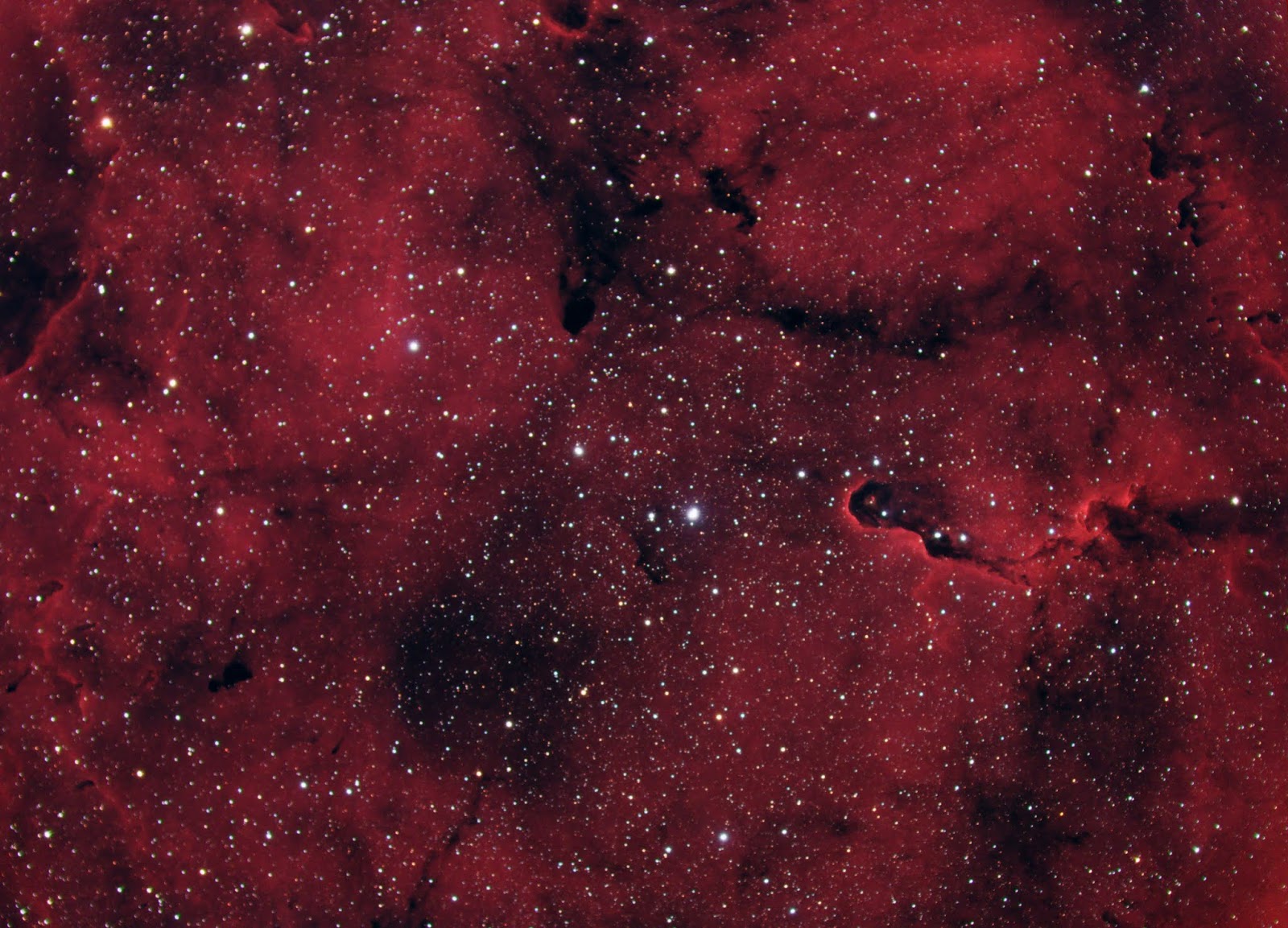
The Elephant's Trunk Nebula (IC 1396) is located in the constellation Cepheus about 2,400 light years away from Earth. The gas and dust in and around the Elephant's Trunk are being illuminated and ionized by a very bright, massive star (HD 206267). The Elephant's Trunk appears on the right side of the wide field image and is light up on the sides.
Although it took a while to process, I did not really have to do much in PI or PS. I am growing very fond of this new monochrome cooled camera as images appear virtually noise free compared to what I used to capture. I especially like how the Elephant's Trunk resembles a canyon upon close examination. The trunk itself is a dark elongated area composed of gas and dust with many young proto-stars not visible with optical telescopes. It is revealed by the Spitzer Telescope's infra red detectors (http://coolcosmos.ipac.caltech.edu). The wide field image shows much of the nebulosity of the whole region as well as the colorful star field.
I believe the camera has taken my telescope to its limit, meaning I need a new telescope. The F7.5 ED80 has been a proven workhorse and all my telescope deep sky images on Astrobin have been taken with it. It is a very sturdy, inexpensive telescope at less than $500. Although it is listed as an apochromatic, it is a doublet with extra-low dispersion glass on one of the lenses, still OK, just not a triplet. I do recommend it for anyone who wants to get started in AP but you might get a better deal if you just start of with a slightly more expensive triplet if the accessories are included.
For example, the Orion currently lists the ED80 at $479 for the optical tube only and single speed focuser. Add in the rings, dual speed focuser, and diagonal standard on most entry level 80mm triplets and you are up to $800 or more. The Astro-Tech AT80 currently lists at $749. You may be able to this scope cheaper on Ebay or you get it as a package deal with the Sirius mount which includes all the extras. Of course I did neither and opted for the more expensive way. I suppose this little review would be better served on a buyers guide or something since most Astrobin users are far beyond the ED80.
I believe the camera has taken my telescope to its limit, meaning I need a new telescope. The F7.5 ED80 has been a proven workhorse and all my telescope deep sky images on Astrobin have been taken with it. It is a very sturdy, inexpensive telescope at less than $500. Although it is listed as an apochromatic, it is a doublet with extra-low dispersion glass on one of the lenses, still OK, just not a triplet. I do recommend it for anyone who wants to get started in AP but you might get a better deal if you just start of with a slightly more expensive triplet if the accessories are included.
For example, the Orion currently lists the ED80 at $479 for the optical tube only and single speed focuser. Add in the rings, dual speed focuser, and diagonal standard on most entry level 80mm triplets and you are up to $800 or more. The Astro-Tech AT80 currently lists at $749. You may be able to this scope cheaper on Ebay or you get it as a package deal with the Sirius mount which includes all the extras. Of course I did neither and opted for the more expensive way. I suppose this little review would be better served on a buyers guide or something since most Astrobin users are far beyond the ED80.
Wide Field HaRGB
Wide Field Ha

Crop HaRGB

Location: Home Monroe, CT
Date: 9-4-18 (Ha), 9-5-18 (RGB)
Camera: ZWO ASI1600MM-Pro
Telescope: Orion ED80 80mm f/7.5 Apochromatic Refractor Telescope
Barlow: None
Focal Length: 600mm
f/7.5
Focal Reducer: Orion 0.8x Focal Reducer for Refractor Telescopes
Mount: Orion Sirius EQ
Filter Wheel: ZWO EFW 8x 1.25"
Filter: ZWO Ha, R, G, B
Autoguiding: QHY-5L-II-M attached to an Agena 50mm Guide Scope with Helical Focuser
Exposure: 9/4-(Ha) 34 x 300s, 9/5-(R) 30 x 60, (G) 19 x 60, (B) 20 x 60
Gain: 139
Offset 21
Temp: -10 C
Processing: APT, PixInsight and Photoshop
https://kurtzeppetello.smugmug.com/
Saturday, September 8, 2018
NGC 6823 (and SH2-86) - HaRGB Processing in PixInsight
NGC 6823 is an open cluster surrounded by a nebula complex Sh2-86 in the constellation of Vulpecula. The open star cluster is about 50 light years across and lies about 6000 light years away. The center of the cluster formed about two million years ago and is dominated by bright young blue stars (source: wikipedia and Astronomy).
I wrote up a comparison between two methods for producing HaRGB images below. The two methods are as follows: method 1 - using the LRGB combination and method 2 - using PixelMath. If you are not familiar with PixelMath I recommend watching the Harry's Astro Shed video Adding Ha to RGB which is the procedure I followed.


Version2
For this next addition I added the Enhanced Ha the LRGB function. Enhanced Ha was added to the luminosity channel at 0.65 intensity.


Version 4
Toned down the red channel, minor sharpening and noise reduction in Photoshop

Version 5
Added the RGB star colors using photoshop and then back to PI - PixelMath, StarMask, and Morphological Transformation.

Comparison

NGC 6823 (and SH2-86) - HaRGB Processing in PixInsight
I captured this object last year (image) using a UHC filter (29x180s) and Canon T3i and processed it using my former method. This new image HaRGB was captured using the ZWO ASI1600MM-Pro and processed primarily using PixInsight.
I wrote up a comparison between two methods for producing HaRGB images below. The two methods are as follows: method 1 - using the LRGB combination and method 2 - using PixelMath. If you are not familiar with PixelMath I recommend watching the Harry's Astro Shed video Adding Ha to RGB which is the procedure I followed.
Creating the HaRGB Image
1) Registering, aligning, and stacking was done in PixInsight using the Batch Preprocessing function. I followed Chuck's Astrophotography (Stack and Combine Filters in PixInsight) method to do this.
2) Automatic Background Extraction was run on the Ha channel to make the Ha image.
Ha

Method 1 - Using LRGB Function to create the HaRGB image
For this method I did not use anyone's specific directions, it was described on numerous websites and forums.
3) An RGB Image was created using the RGB combination function. Processing included: ABE, Color Calibration, SNCR noise reduction, HistogramTransformation, Extract CIE Component, Reduce star size - Star Mask - Morphological Transformation, Sharpness and Saturation - Mask - Convolution. This was only for show as the image was not used for anything.
RGB

4) The simplest HaRGB Image was created by combining the separate channel using the LRGB process and the Ha was put into the Luminosity channel at 0.5 strength. Further processing included: ABE, Color Calibration, HistogramTransformation, Extract CIE Component, Reduce star size - Star Mask - Morphological Transformation, Sharpness and Saturation - Mask - Convolution.
HaRGB - Simple

In my opinion this image was better than my image from last year and the star colors came out very well. However I was not satisfied with the detail or the look so I did some more research on combining HaRGB. Most experienced PI users do not use the LRGB process to combine Narrowband data but rather a process using the PixelMath function.
Method 2 - Using PixelMath to create the HaRGB image
For this method I chose Harry's Astro Shed video Adding Ha to RGB to complete the combination (http://harrysastroshed.com/pixinsight/pixinsight%20video%20html/pixinsighthomeinter.html).
3) The original was Ha image which ABE was already run was further enhanced using the using the following script: ((Ha*100)-(R*7)/(100-7) added to RGB/K channel. That is the Ha image (Ha) and the Red Channel (R) are merged and the unwanted Ha is subtracted out of the image. The '7' is the filter size and the '100' is I believe the intensity which can be adjusted. I ended up using 140 for my image.
Enhanced Ha

4) Next up was adding the Enhanced Ha image to the Red channel again using PixelMath. I used the following script for this: $T+(Enhanced Ha-Med(Enhanced Ha))*4 and then applying this to the Red Channel. What you get is an Enhanced Red Channel image. The number '4' is the scale and can be adjusted to give the optimal look.


Red Channel

Enhanced Red Channel
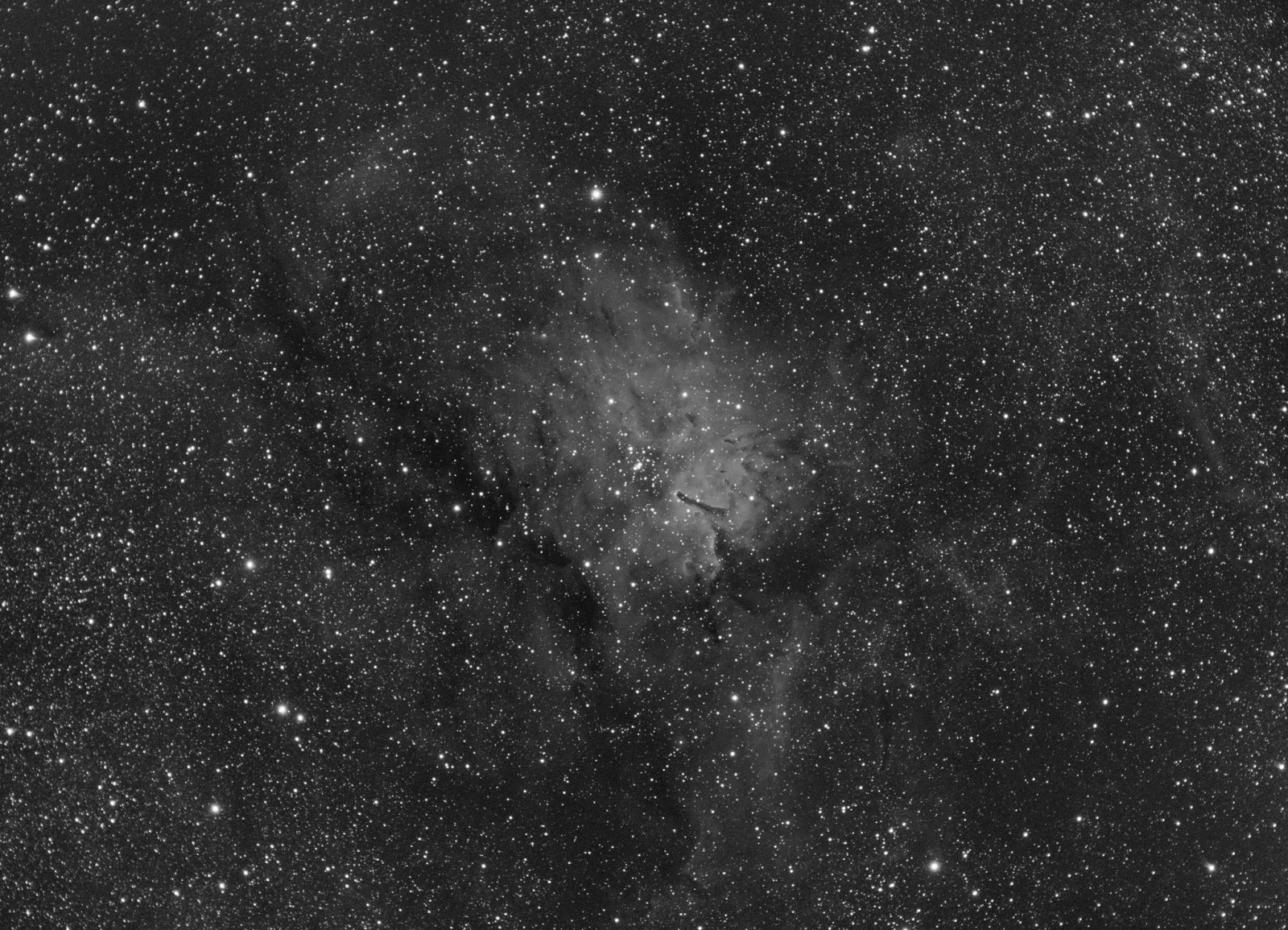
5) Finally you can combine your RGB channels using the Enhanced Red Channel to make the HaRGB image. Further processing included: HistogramTransformation, Extract CIE Component, Reduce star size - Star Mask - Morphological Transformation, Sharpness and Saturation - Mask - Convolution.

In my opinion this method produced a far superior image than the simple LRGB method (method 1). The detail and sharpness are greatly enhanced using the PixelMath process (method 2). However, I do like the star colors of the LRGB method and will attempt to add them to the image using a star mask. I did no processing in Photoshop except for file saving as I wanted to show a comparison between HaRGB images using the LRGB method and the PixelMath method. I will add updated versions of the final image when they become available.
HaRGB-v1

Finally
Version2
For this next addition I added the Enhanced Ha the LRGB function. Enhanced Ha was added to the luminosity channel at 0.65 intensity.
HaRGB-v2

Version 3
Toned down the red channel, minor sharpening and noise reduction in Photoshop
HaRGB-v3

Version 4
Toned down the red channel, minor sharpening and noise reduction in Photoshop
HaRGB-v4

Added the RGB star colors using photoshop and then back to PI - PixelMath, StarMask, and Morphological Transformation.
HaRGB-v5

Comparison

Location: Home Monroe, CT
Date: 8-28-18 (Ha), 8-29-18 (RGB), 8-30-18 (RGB), 9-2-18 (RGB), 9-3-18 (Ha)
Date: 8-28-18 (Ha), 8-29-18 (RGB), 8-30-18 (RGB), 9-2-18 (RGB), 9-3-18 (Ha)
Camera: ZWO ASI1600MM-Pro
Telescope: Orion ED80 80mm f/7.5 Apochromatic Refractor Telescope
Barlow: None
Focal Length: 600mm
f/7.5
Focal Reducer: Orion 0.8x Focal Reducer for Refractor Telescopes
Mount: Orion Sirius EQ
Filter Wheel: ZWO EFW 8x 1.25"
Filter: ZWO Ha, OIII, SII
Autoguiding: QHY-5L-II-M attached to an Agena 50mm Guide Scope with Helical Focuser
Exposure: (Ha 8/28) 44 x 180s, (Ha 9/3) 29 x 180, (R) 63 x 60, (G) 52 x 60, (B) 47 x 60
Telescope: Orion ED80 80mm f/7.5 Apochromatic Refractor Telescope
Barlow: None
Focal Length: 600mm
f/7.5
Focal Reducer: Orion 0.8x Focal Reducer for Refractor Telescopes
Mount: Orion Sirius EQ
Filter Wheel: ZWO EFW 8x 1.25"
Filter: ZWO Ha, OIII, SII
Autoguiding: QHY-5L-II-M attached to an Agena 50mm Guide Scope with Helical Focuser
Exposure: (Ha 8/28) 44 x 180s, (Ha 9/3) 29 x 180, (R) 63 x 60, (G) 52 x 60, (B) 47 x 60
Gain: 139
Offset 21
Temp: -10 C
Processing: APT, PixInsight and Photoshop
https://kurtzeppetello.smugmug.com/
Offset 21
Temp: -10 C
Processing: APT, PixInsight and Photoshop
https://kurtzeppetello.smugmug.com/
Subscribe to:
Posts (Atom)